The Church of the Most Holy Trinity is the Roman Catholic Parish Church of Dockhead.
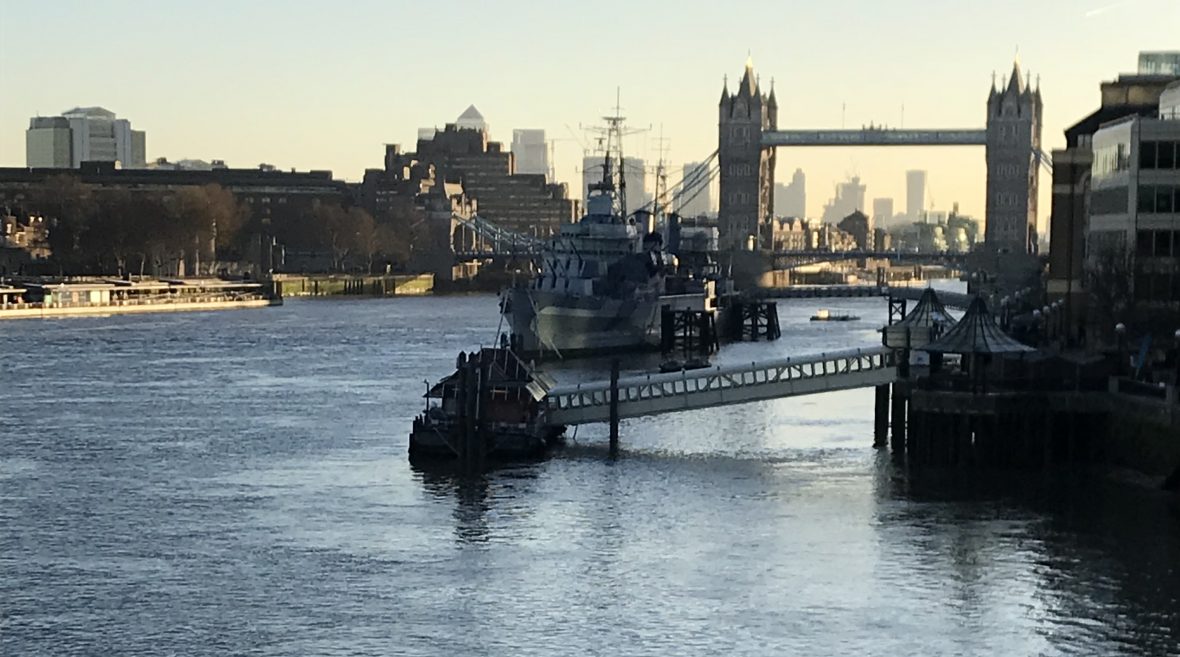
Dockhead is an area situated just north of Jamaica Road in Bermondsey and runs east/west just south of Tower Bridge. Named to describe its geographical position at the “Head” of the London docks on the South side of the Thames, Dockhead was home to the Dockers, Stevedores and Lightermen who worked in the Docks up until their demise in the 1970s and 1980s and in terms of my family history, home to most of my Mother’s family during the nineteenth century and up until the Docks’ decline. I lived just off Jamaica Road not far from Tower Bridge when I was a child in the 1950s and my Dad and several of his brothers all worked in the London Docks.
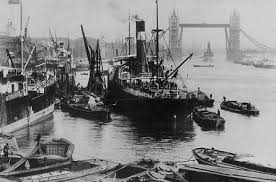
The Docks were known as the ‘larder of London’. Everything came through these Docks, frozen meat, spices, tobacco, wool. All unloaded and distributed from the huge ships that came up the Thames up to Tower Bridge or stored in the vast network of Warehouses on both sides of the Thames. Three-quarters of the butter, cheese and canned meat needed for the capital was stored here.
The London Docks, south side of the Thames, looking West, upstream around 1940s
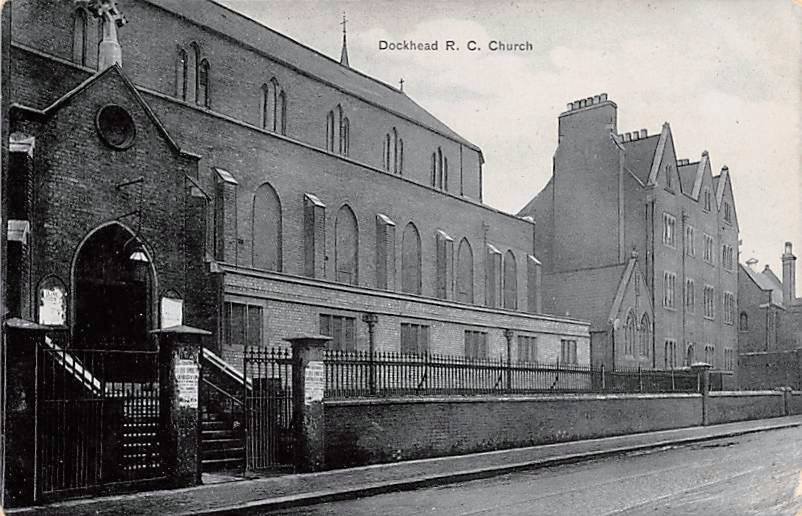
There has been a Roman Catholic Church on the site of the Most Holy Trinity Church since at least 1773 and it was the first church to be built fronting a public highway since the Reformation.
The Church of the Most Holy Trinity, Dockhead about 1907
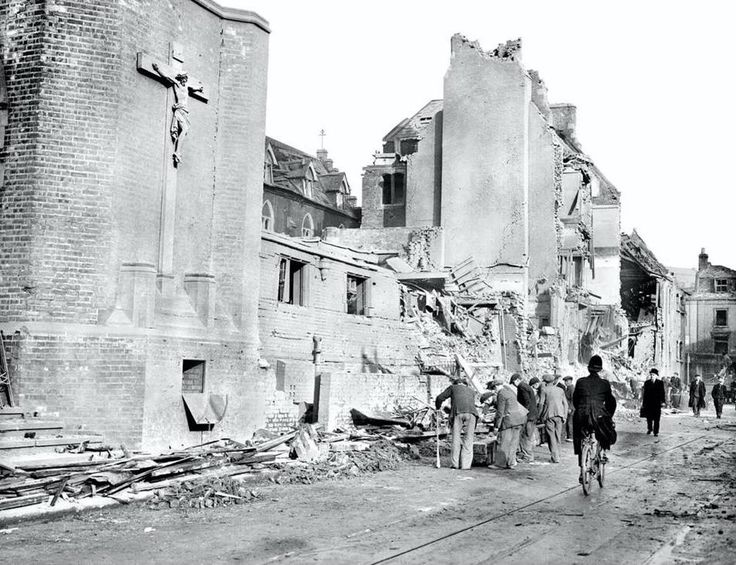
Dockhead suffered terribly during the Blitz in WW2 due to its proximity to the Docks. Between 7 October 1940 and 6 June 1941, 126 high explosive bombs and 2 Parachute Mines were dropped on the area (https://www.bombsight.org) and in December 1940, the Church was destroyed in a bombing raid. Sadly, five years later, just before the end of the War on 2 March 1945, the Priests’ House was also bombed and three of the four Parish Priests were killed. The fourth was badly injured and rescued only with great difficulty. His rescuer, a milkman, received the George Cross. The adjoining Convent of the Sisters of Mercy was also damaged but with no loss of life. I can’t help thinking that my family must have known the Priests and were almost certainly members of the congregation.
The Church immediately after it was bombed
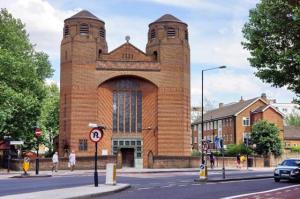
But the Church was eventually rebuilt and the present polychromatic brick building (first illustration above) was designed by H.S. Goodhart-Rendel and completed in 1959. The modern building was designated Grade II Listed but was upgraded to Grade II* in 2015.
The Church features heavily on my Maternal family tree. So far, I have found 12 marriages and 3 Baptisms at the Church from 1852 to 1931.
The furthest back of these is the first marriage of my 2 x great Grandmother, Hannah Lyons, who married a Michael Taylor there in 1852.
Hannah was born in Ireland in the early 1830s (not sure exactly when) and was living in England by the time of her marriage to a Michael Taylor in 1852.
It may have been that Hannah’s family came to England a s a result of what became known as “The Irish Potato Famine” between 1845 and 1852 when almost 2.2m people mostly from southern and western Ireland emigrated to England or America following the failure of the potato crop on which they depended, predominantly due the infection of potato crops by a blight that affected crops in other countries in Europe as well. Over 1m people starved to death in Ireland alone.
Hannah and Michael continued to live in Bermondsey and had three children. Johanna who was the mother of the Kalaher orphans who were the subject of an earlier blog post on here (see link below), John and Julia who was my great grandmother.
Michael Taylor died in 1874 from Bronchitis (not unusual then in this damp area around the London Docks) aged 46.
Hannah remarried a couple of years later to a Thomas Sullivan but by 1891 Hannah is again a widow. Hannah’s two younger children, John and Julia, are still with her but by then Hannah’s other daughter, Johanna and her husband had both died leaving their children orphaned and Hannah has taken three of them to live with her.
On the 1901 census, Hannah is living with her youngest daughter Julia and Julia’s husband and she died just a few months later aged 65.
Both Hannah and Michael’s daughters, Johanna and Julia married at Holy Trinity (Julia giving birth to her first child just five days later) as did Julia’s daughter, also called Hannah (my grandmother) two of her other daughters and her son who were all my great Aunts and Uncles.
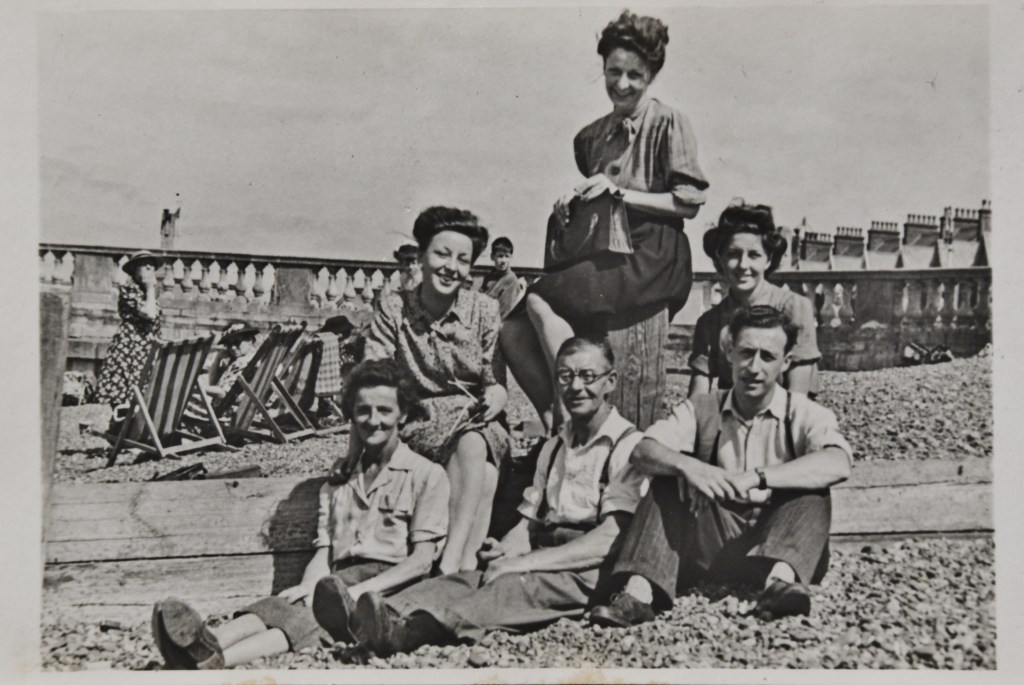
I can’t find any photos of my Grandmother and grandfather’s wedding (perhaps there weren’t any …) but here’s the little family they made including my lovely Mum, Marie and her sisters Hannah (this Hannah was baptised at Holy Trinity too) and Eileen plus Hannah’s husband enjoying a day at the beach I’m guessing in the late 1940s, perhaps early 1950s.
Thank you for reading this and I’m sorry I’ve been away so long ❤️
The Kalaher orphans, all six of them, are my 1st cousins twice removed. They have fascinating stories and I have worked out that my maternal Grandmother, Hannah, who was their cousin, must have known at least some of them. I find that extraordinary. As the actress Olivia Coleman said in her episode of Who Do You think You Are, “we have touched hands through time”.
My Great great Aunt, Johanna Taylor (1856 – 1887) who was my Great grandmother’s sister, married a Bartholemew Kalaher at the Roman Catholic Church of the Most Holy Trinity in Dockhead (named since this area was literally the Head of the then vibrant London Docks) in Bermondsey in June 1873. Bartholemew was a Labourer and he and Johanna were living just a few doors away from each other near the Thames in Bermondsey when they were married.
The Church of the Most Holy Trinity, Dockhead, Bermondsey
Like most poor people in Bermondsey at that time, Bartholemew and Johanna moved around a lot but never far from where they had grown up and where they were living when they got married.
Johanna and Bartholemew had seven children,
Mary Ann born 1874,
John born 1875
Thomas born 1877 (died in 1886 aged just 9 from Heart Disease)
Ellen born 1879
Catherine born 1883
James born 1885 and
Albert born 1886
In December of 1887, when her youngest child was just over a year old, Johnna developed Bronchitis and died aged just 31. Her husband, Bartholemew registered her death and was left with six children to look after. But there was more tragedy to follow when in the following May, aged just 34, Bartholemew himself died from Broncho-Pneumonia. Bartholemew’s death was registered by Johanna’s sister Julia Taylor, my great grandmother who was to play a rôle in some of her nieces’ and nephews’ lives in the coming years.
So, what happened to the Kalaher orphans?
Well. Mary Ann, James and John went to live with their Grandmother, Hannah Lyons (my great great Grandmother). Ellen and Catherine went to a Roman Catholic Orphanage and poor little Albert Kalaher ended up in the Horsleydown Workhouse where he died in January 1889 aged just 2 from TB, Ricketts and Diarrhoea.
Albert’s Death Certificate is the saddest thing I have seen in all my time researching family history.
Albert Kalaher 1886 – 1889
Albert was actually just turned 2 when he died, although his Death Certificate says 18 months. It seems that no-one knows who his parents were with the Certificate merely noting “Parents names and occupations unknown. Both parents deceased”. I wonder whether any of Albert’s family knew that he had died? I wonder where he was buried? Did he have a funeral? So sad. Poor little thing.
Ellen Kalaher and Catherine Kalaher were sent to The Convent of the Faithful Virgin, Boarding School and Orphanage, Central Hill, Upper Norwood in South East London. They were aged 9 and 5 respectively in 1888 when they were orphaned.
This must have seemed like going to the other side of the world for these girls who were unlikely ever to have left Bermondsey where all their family still lived. I imagine the only solace for them must have been that they had each other.
Well, only until 1894 when Catherine, the younger sister, died at the Orphanage aged 11 of Heart Disease and Exhaustion. Ellen was now alone.
But she survived and in 1900 when she was 21, she married a Stephen Mitchell at the Church of the Most Holy Trinity in Dockhead where her parents had married 27 years before, so she had come back home. Ellen’s family must have stayed in touch with her throughout her years at the orphanage though because her sister Mary Ann had by this time got married and her husband is a witness. Also, Ellen gives the same address as her Aunt Julia Taylor and Uncle John Cownley (my great Grandparents) give on the 1901 Census so I assume she was living with them when she got married.
Ellen and Stephen went on to have seven children. Ellen was widowed in 1922 and is on the 1939 Register with four of her grown up children, by now in their thirties.
So, that is three of the six orphans but what about the three who went to live with their Grandmother?
First, the eldest, Mary Ann Kalaher. After she was orphaned in 1888, Mary Ann went to live with her Grandmother, Hannah Lyons, and is on the Census with Hannah in 1891. The family lived in Queen Elizabeth Street right on the South bank of the Thames by Tower Bridge.
Also living there are Mary Ann’s two brothers John and James and Hannah’s two grown up children John and Julia (my great Grandmother). Hannah was a widow by this time. Mary Ann was a witness at her Aunt, Julia Taylor’s, wedding to John Cownley in 1893 and was only 7 years younger than her Aunt so presumably the two of them became friends.
Mary Ann married a John Henry Gover Shaw in 1896 again at the Church of the Most Holy Trinity in Dockhead, Bermondsey. John Shaw lived in Grays Inn Road and his Father was a Methodist Minister. This is a bit unusual for this family. Mostly they married Dockers or Labourers and from a very small area around Dockhead. Grays Inn Road is quite a stretch for a girl from Bermondsey in those days. John Shaw worked in the Print and was ten years older than Mary Ann.
Mary Ann and John Shaw went on to have three children
Mary Isabella born 1897
John Bartholomew born 1895 and
Stephen Martin Michael born 1905
When their first child was born, Mary Ann and John Shaw are living in Beckenham. This is really the first time I have found members of this family leaving Bermondsey. But by the time their second child was born, they are back in Camberwell, where they stayed certainly until the 1901 census. But by 1905, when their third child was born, Mary Ann and John Shaw have moved to St Albans in Hertfordshire where they still lived when the 1911 Census was taken.
In 1911, both their elder children are at Roman Catholic Boarding Schools. This is an interesting portent for the lives of the two boys.
Firstly, John Bartholomew Shaw served as a Pilot Officer (2nd Lieutenant) in the RAF during WW1. He started on 23 April 1918 and was a “Handley Page” pilot which seems to mean he tested the new super bomber designed by a company called Handley Page (but made too late to be effective in the war). John ceased flying on 26 November 1918 and was “Dispersed” at Purfleet early in 1919.
It seems that John had already started to train for the Priesthood prior to his Military Service and he returned to his studies after 1919. John was ordained at Westminster Cathedral in 1923, appointed a Canon of the Westminster Chapter in 1955 and served continuously as a Parish Priest around London until his retirement in 1967. He went back to his Parish in Fulham, where he had been Parish Priest from 1953 to 1967, to live out his retirement until he died in December 1981 aged 82.
The Vicar General of the Westminster Diocese, Monsignor Martin Hayes, told me that Canon John’s Requiem Mass was held in Latin and celebrated with “great solemnity” at St Thomas’s Church, Fulham, where John served, and Canon John’s soul is prayed for every year at Westminster Cathedral on the anniversary of his death, 19 December.
John Bartholemew Shaw 1899 – 1981 taken from a very grainy photo in a Parish Magazine in about 1970
Then John Shaw’s brother, Stephen Martin Michael Shaw, also became a Priest. Having completed his training for the Priesthood, Stephen was ordained in 1928 aged 23.
Stephen also served as a Parish Priest around London until he was appointed as the National Director of the Pontifical Aid Society in 1947, a post which he held until 1970 when he was made “Protonory Apostolic” (ProtAp) and travelled frequently to Rome for consultations and discussions with the Pope and members of the Vatican Council. ProtAp means that Stephen was an honorary Prelate (a senior member of the Clergy) upon whom the Pope has conferred this title and its special privileges, including the title “Monsignor”.
Stephen retired to Killarney in Ireland due to ill health and died there on 13 May 1998 aged 92, following a Stroke. Stephen’s funeral was at Killarney Cathedral on 15 May 1998 and he is buried in a cemetery nearby. Monsignor Stephen missed out on his 70th Ordination anniversary by only about a week and at the time of his death was the longest serving Westminster Priest. He was also a published author of at least four Religious books.
John and Stephen’s elder sister, Mary Isabella Shaw, married a William Sait in 1926. The ceremony was carried out by her brother, John. Mary continued to live in the Hertfordshire area before her death in 1996 aged 99 in Exeter near to where her son, Michael Sait lived. Michael registered both his Uncle John’s and his Mother’s deaths.
The next Kalaher orphan is John Kalaher. John was about 12 when he was orphaned. In 1891, he was living with his Grandmother, Hannah Lyons and in 1892 he joins the Army aged just 16 and served in 4th Battalion East Surrey Volunteer Regiment. After that, I can find nothing for John. Not a marriage, a family, an entry on the 1939 Register or a death.
Lastly James Kalaher. James was only 3 when he was orphaned in 1888. He too went to live with his Grandmother, Hannah Lyons, along with his brother, James, and his sister, Mary Ann. James is with his Grandmother, her two youngest children (who are his Aunt and Uncle) and his brother and sister in 1891 when he is five.
I cannot find James on the 1901 Census but in 1902, he joins the Army aged nearly 18 and gives the address my great Grandmother (Julia Taylor) and great Grandfather (John Cownley) give on their 1901 Census return so he was presumably, living with them. James joins the same volunteer Battalion in which his brother John served.
In 1911, James is working as a Blacksmith’s Mate and is still living with his Aunt and Uncle, Julia and John and their family including my grandmother, Hannah Cownley, who was 14 by then so presumably Hannah knew James, although he was much older than her.
On 2 June 1915. James married an Alice Markham, again, in the Church of the Most Holy Trinity, Dockhead and ten days later (hold that moment …) their first child, Alice Victoria Kalaher, is born.
In 1916, James is discharged from the Army. By this time, he is serving in a different Regiment, the King’s Royal Rifle Corps. He has a different Army Number from when he joined the Volunteer Regiment in 1902 and I suspect this may have been a Regular Battalion but I am not sure. The Attestation states that he joined the Army from the Reserve which makes sense. Given WW1 was on, though, it seems strange to release a man from the Army when others were being called up.
However, James and Alice continued to live in Bermondsey, have five children, and James gives his occupation as an Iron foundry Labourer. There was a huge Iron foundry in Bermondsey, owned by the General Iron Foundry Company that provided work for hundreds of men during the 1920s and 1930s and this was presumably where James worked.
But things took an unfortunate turn for James and Alice in the late 1920s when their children were still very young (aged between 13 and 5). On 11 December 1928, James was admitted to Banstead Mental Hospital which was in Sutton in Surrey. The Admissions register reveals that James was diagnosed as suffering from “Melancholia” which in those days was considered to be on the “Lunatic” spectrum. Nowadays, I understand the diagnosis would be Severe Depression. It occurs to me that this may have been a legacy of James’s service in WW1 and perhaps, the reason for his discharge in 1916 when the War was at its height.
Banstead Asylum [Mental Hospital]
Sadly, poor James was never discharged from this Mental Hospital and he died there on 13 June 1944. The Death Certificate gives “Myocardial Degeneration, Emphysema and Bronchitis” as the cause of his death but the hospital records reveal that James was considered, at the time of his death, to be suffering from “Chronic Melancholia” which would seem to be a worse kind of what they then thought was Lunacy. I suppose that if he had been in a mental hospital for sixteen years and was still suffering from Depression (and why wouldn’t he?) that it was now considered to be a “Chronic” case. James was buried in the graveyard of the Hospital.
Alice, James’s wife, continued to live in Bermondsey with their children and on the 1939 Register is living with just their youngest child who by this time was aged 24.Alice died in Leicestershire in 1959 aged 66. Hers and James’ eldest daughter had married in 1936 and Alice’s Death is registered by this daughter in her married name living at the same address at which Alice had died. I presume Alice had gone to Leicestershire in later life to live with her daughter and her daughter’s husband.
So that’s the Kalaher orphans. Different times and hard experiences. But at least three if not four of them had good lives given the times they were living in. I only wish I had known about them when my grandmother, Hannah, was still alive and I could have asked her what they were really like …


 Linda Swinburne Family History Blog