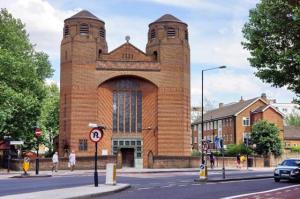
The Church of the Most Holy Trinity, Dockhead, Bermondsey

The Church of the Most Holy Trinity, Dockhead

The Church of the Most Holy Trinity is the Roman Catholic Parish Church of Dockhead.

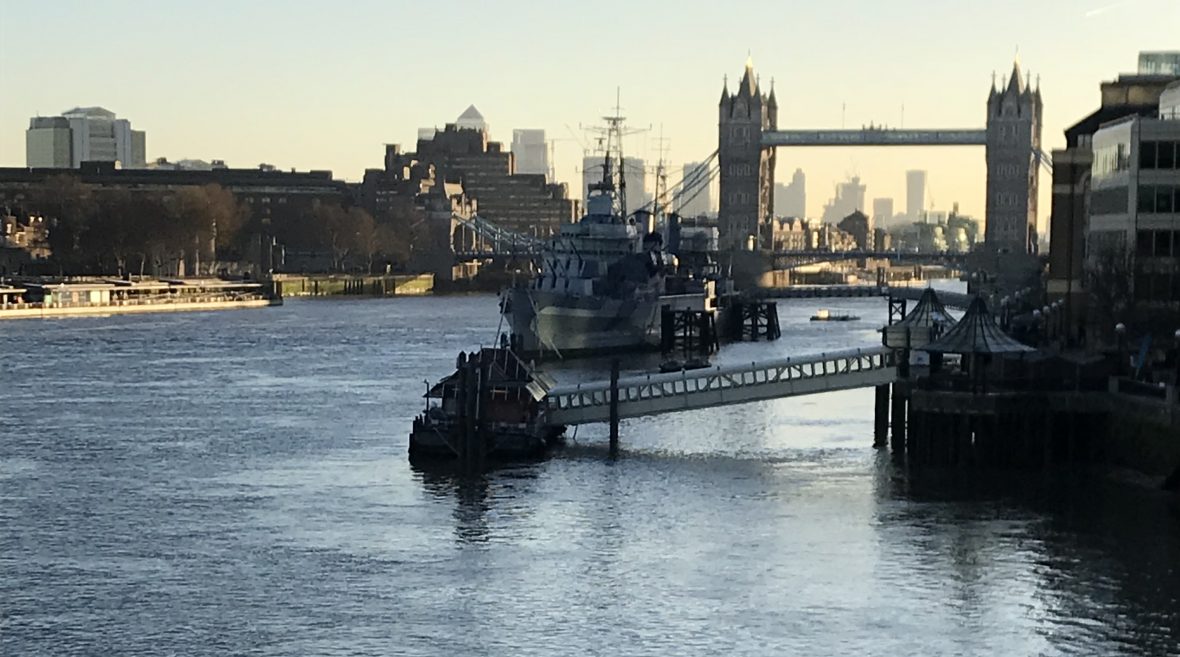
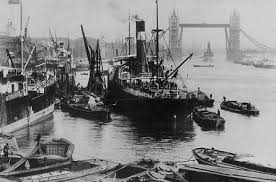
Dockhead is an area situated just north of Jamaica Road in Bermondsey and runs east/west just south of Tower Bridge. Named to describe its geographical position at the “Head” of the London docks on the South side of the Thames, Dockhead was home to the Dockers, Stevedores and Lightermen who worked in the Docks up until their demise in the 1970s and 1980s and in terms of my family history, home to most of my Mother’s family during the nineteenth century and up until the Docks’ decline. I lived just off Jamaica Road not far from Tower Bridge when I was a child in the 1950s and my Dad and several of his brothers all worked in the London Docks.

The Docks were known as the ‘larder of London’. Everything came through these Docks, frozen meat, spices, tobacco, wool. All unloaded and distributed from the huge ships that came up the Thames up to Tower Bridge or stored in the vast network of Warehouses on both sides of the Thames. Three-quarters of the butter, cheese and canned meat needed for the capital was stored here.
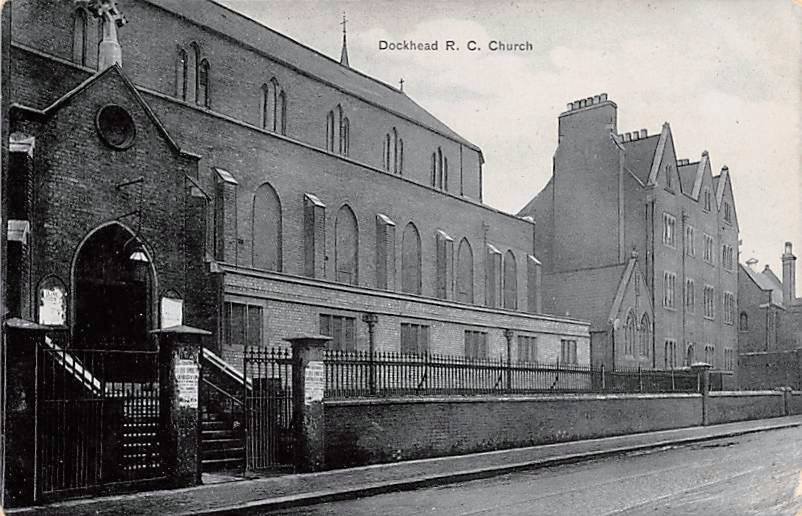
There has been a Roman Catholic Church on the site of the Most Holy Trinity Church since at least 1773 and it was the first church to be built fronting a public highway since the Reformation.
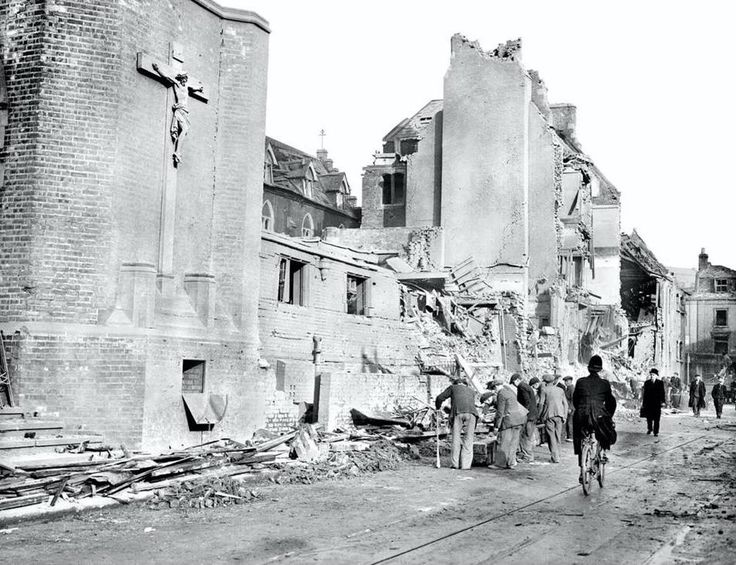
Dockhead suffered terribly during the Blitz in WW2 due to its proximity to the Docks. Between 7 October 1940 and 6 June 1941, 126 high explosive bombs and 2 Parachute Mines were dropped on the area (https://www.bombsight.org) and in December 1940, the Church was destroyed in a bombing raid. Sadly, five years later, just before the end of the War on 2 March 1945, the Priests’ House was also bombed and three of the four Parish Priests were killed. The fourth was badly injured and rescued only with great difficulty. His rescuer, a milkman, received the George Cross. The adjoining Convent of the Sisters of Mercy was also damaged but with no loss of life. I can’t help thinking that my family must have known the Priests and were almost certainly members of the congregation.
But the Church was eventually rebuilt and the present polychromatic brick building (first illustration above) was designed by H.S. Goodhart-Rendel and completed in 1959. The modern building was designated Grade II Listed but was upgraded to Grade II* in 2015.

The Church features heavily on my Maternal family tree. So far, I have found 12 marriages and 3 Baptisms at the Church from 1852 to 1931.

The furthest back of these is the first marriage of my 2 x great Grandmother, Hannah Lyons, who married a Michael Taylor there in 1852.

Hannah was born in Ireland in the early 1830s (not sure exactly when) and was living in England by the time of her marriage to a Michael Taylor in 1852.

It may have been that Hannah’s family came to England a s a result of what became known as “The Irish Potato Famine” between 1845 and 1852 when almost 2.2m people mostly from southern and western Ireland emigrated to England or America following the failure of the potato crop on which they depended, predominantly due the infection of potato crops by a blight that affected crops in other countries in Europe as well. Over 1m people starved to death in Ireland alone.

Hannah and Michael continued to live in Bermondsey and had three children. Johanna who was the mother of the Kalaher orphans who were the subject of an earlier blog post on here (see link below), John and Julia who was my great grandmother.

Michael Taylor died in 1874 from Bronchitis (not unusual then in this damp area around the London Docks) aged 46.

Hannah remarried a couple of years later to a Thomas Sullivan but by 1891 Hannah is again a widow. Hannah’s two younger children, John and Julia, are still with her but by then Hannah’s other daughter, Johanna and her husband had both died leaving their children orphaned and Hannah has taken three of them to live with her.

On the 1901 census, Hannah is living with her youngest daughter Julia and Julia’s husband and she died just a few months later aged 65.

Both Hannah and Michael’s daughters, Johanna and Julia married at Holy Trinity (Julia giving birth to her first child just five days later) as did Julia’s daughter, also called Hannah (my grandmother) two of her other daughters and her son who were all my great Aunts and Uncles.

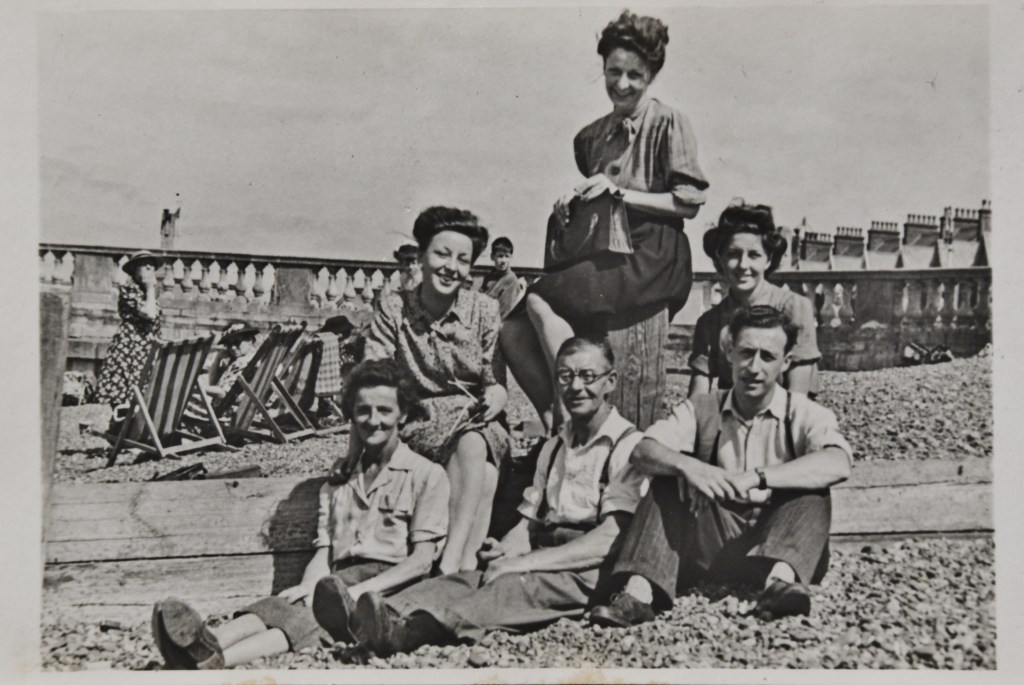
I can’t find any photos of my Grandmother and grandfather’s wedding (perhaps there weren’t any …) but here’s the little family they made including my lovely Mum, Marie and her sisters Hannah (this Hannah was baptised at Holy Trinity too) and Eileen plus Hannah’s husband enjoying a day at the beach I’m guessing in the late 1940s, perhaps early 1950s.
Thank you for reading this and I’m sorry I’ve been away so long ❤️
The Bermondsey Women’s Uprising

In this week of International Women’s Day, I thought it would be appropriate to celebrate women who have taken a stand.

When my maternal great grandfather, John Cownley, completed the Census in Bermondsey, Dockhead in 1911, he noted that three of his six children worked in factories locally.

All of those were his daughters. One of those daughters was my grandmother, Hannah.

My grandmother was just 14 and working as a “Factory Hand – Labeller, Drugist”, her older sisters Mary Ann, 17 and Lizzie, 16 were working as a “Tin Worker” and a “Book Folder” respectively.

Descriptions of factory working give us a fascinating insight into early 20th century life in Bermondsey.

At that time, Bermondsey was famous for manufacturing trades that were based there. Jacobs Cream Crackers, Cross and Blackwell, Hartley’s Jam (employing 1,500 people), Pinks Jam, Courage Beer, Spiller’s dog biscuits, Sarsons Vinegar, Shuttleworths Chocolate, Liptons Tea, Pearce Duff Custard Powder and Confectionery and Peak Frean Biscuits (probably the biggest employer in the area at 2,500 workers) were among the Bermondsey factories of which there were over 23 in 1911.

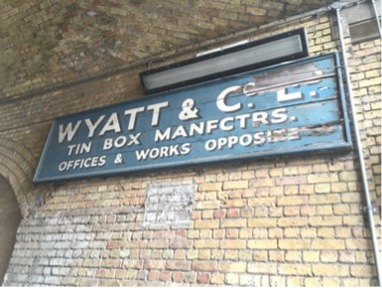
Also, the manufacture of metal boxes – like tins for holding baked beans and biscuits for example – was also carried out in Bermondsey. My great Aunt, Mary Ann mentioned above probably worked for a company called Wyatt & Co., one of the biggest tin manufacturers in Bermondsey at that time. The factory was in Tanner Street, SE1 so not far from where the Cownleys were living in 1911 and the building was not demolished until the 1950s.

Staggeringly, there is still a wooden sign in place today that belonged to Wyatt & Co despite the immense redevelopment that has taken place in the area over the last 50 or 60 years.

Wyatt & Co., Tin Manufacturer

Work in all the factories was hard, dangerous, poorly paid and mostly done by women (supervised by men who – it was ever thus – earned more than them). Most men, though, worked in heavier industry in the Docks or digging the roads. In the tin factory, women often lost fingers on unguarded machinery and cheap glass was used in the jam factories causing it to explode sometimes when the hot jam was poured in causing injury and sometimes blindness to the women on the production line.  

The factories were not always small and cramped though. The Hartleys Jam Factory site, for example (which I mentioned in my last Blog at Christmas) was huge but not very mechanised.  Instead it relied on thousands of cheap, mostly female, workers to do endlessly repetitive tasks to produce their jars of jam.

Most women earned less than six shillings a week and those under 16 earned as little as three shillings. My Grandmother, at 14, would have been one of the lower paid workers.

There had been no history of factory workforce unionisation however, unlike in the Docks where over 100,000 workers had gone on strike in 1889 winning recognition for and unionisation of casual labour.

But that Summer of 1911, all that changed. The Summer was a hot one.  With no means of keeping food cool it went off quickly meaning families had less to eat than ever and child mortality had risen sharply over the Summer months.

The Docks and Railway workers had been on strike for weeks nationally, including London, over working conditions and Troops had been brought in, leading to two young pickets being shot dead in Liverpool in the ever increasing strain of the Summer conditions.

Into this hotbed of tension stepped two female trade unionists, Ada Salter and Eveline Lowe (until very recently (2003) there was a school in Southwark called after Eveline Lowe), who formed and convinced hundreds of women to join, the National Federation of Women Workers (the NFWW).

The NFWW called a rally in Southwark Park at which Emeline Pankhurst, the leader of the quest for female suffrage, spoke as well as Ben Tillett, the leader of the Dockworkers’ Union. Quite out of the blue and to everyone’s surprise, on 15 August 1911 at 11 am, over 20,000 women downed tools in the factories and went on strike. Factories ground to a halt.  The manager of the Peak Freans’ biscuit factory was quoted as saying “I don’t know of a single business that is working in the district… It is a reign of terror”.

The Manchester Guardian carried a report of the action the next day (16 August 1911). The reporter noted, 

“At the [Bermondsey] jam works, work really is work. The women frequently have to carry three gallon jars of hot pulp long distances around the factory”.   And in the same article, “There are more women workers in Bermondsey than in any other part of London”.

 Ada and Eveline appear to have been so successful by making the women aware that if they came out on strike they would not be without assistance. Ada set up food depots and kitchens all along the river right from London Bridge down to Woolwich to help the Dockers and the women while they were on strike.  In addition, the NFWW launched an appeal for funds to help the women.  It raised over £500 in one week plus six barrels of Herrings (perhaps pickled at Pickle Herring Street where Elizabeth Regan had lived) (see my blog of 25 August 2020)

Then, towards the end of the Summer, Dockers in London began to be offered settlements by the Port of London Authority (increased wages mostly) if they went back to work.  But they wouldn’t. Not until the women’s grievances were dealt with satisfactorily too. So, for the first time ever, men and women stood together as equals for fair working conditions.

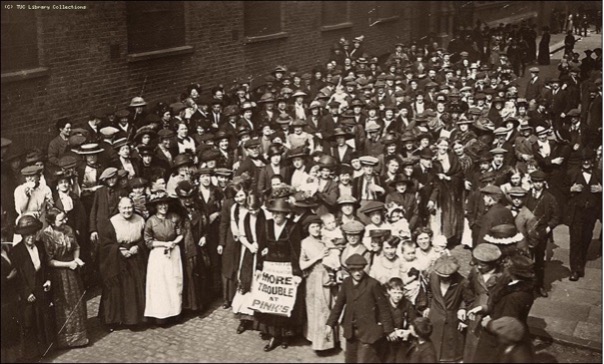
It worked. After several weeks of the factories’ strike, the women were offered and accepted increased pay at nearly all the Bermondsey factories. Of the 21 factories on strike, 19 won substantial wage increases and in most, an end to piece work whereby workers were paid only by the number of finished products they produced. At Pinks the jam factory, which was the last to settle, the weekly wage rate rose from nine shillings to eleven shillings. A massive victory. Most factories resumed normal working by 8 September 1911

I had never heard of this strike, which became known as “The Bermondsey Women’s Uprising”. I find it thrilling that my Grandmother and my great Aunts are very likely to have been part of this event and may even be in the photograph below …


Striking Workers, Pinks Jam Factory, 1911

Up the women eh?

ps. sorry I’ve been a bit quiet. I’ve been rearranging my 20+ years of Genealogy research into a new filing system. It’s taken longer than I thought …

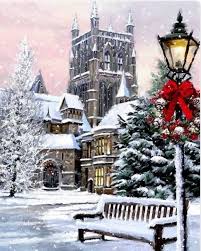
Christmas Weddings

During the 18th and 19th Centuries, it was not unusual for weddings to take place on Christmas Day.

In fact, churches held special events to enable weddings to take place and young couples flocked to get married at Christmas. However, this was not for some desire to capture Christmas romance. The real reason was entirely practical.

With so many people working “in service” (as servants) usually Christmas Day and Boxing Day were the only days off they were likely to get off in the whole year (most people worked six days a week and did not get paid for the one day they didn’t work) and if they wanted to get married, the opportunity to do so on Christmas or Boxing Day would have been very welcome .

Christmas Day is a traditional holiday and is not, and never has been a bank holiday in England, Wales or Ireland. Sir John Lubbock first introduced bank holidays. He was a banker and politician who loved his cricket and couldn’t stand the idea of competitors gaining an advantage by trading on days he and his staff went to support or play in their local village matches. He introduced the Bank Holidays Act 1871 which recognised four official bank holidays – Easter Monday, Whit Monday, the first Monday in August and Boxing Day. The same act did make Christmas Day a bank holiday in Scotland.

On my Mother’s side of my family, I have so far found eight Christmas Day weddings including my own maternal Grandmother, Hannah Cownley, who married Frederick Mason on 25 December 1919.

At the time of their wedding, Hannah and Fred were both living in Bermondsey. Hannah was working as a “Factory Hand at a Jam Factory” and Fred was a “Farrier Journeyman” (so someone who looked after horses’ hooves – can’t imagine needing one of those in Bermondsey now can you?)

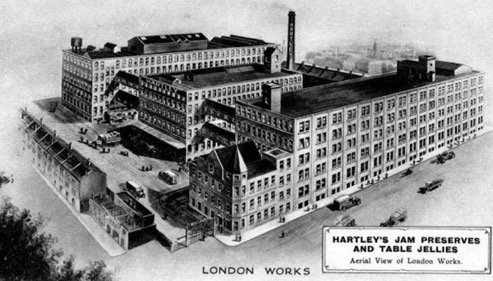
Hannah was likely to have worked at Hartley’s Jam Factory which employed about 1,500 people in Bermondsey at the beginning of the 20th Century.

Hartley’s Jam Factory Bermondsey, 1920s

Neither Hannah nor Fred will have had much time off and I imagine a Christmas Day wedding would have been appealing to them (the other added incentive would doubtless have been that Hannah was about 7 months pregnant with their eldest daughter, also called Hannah and born on 4 March 1920).

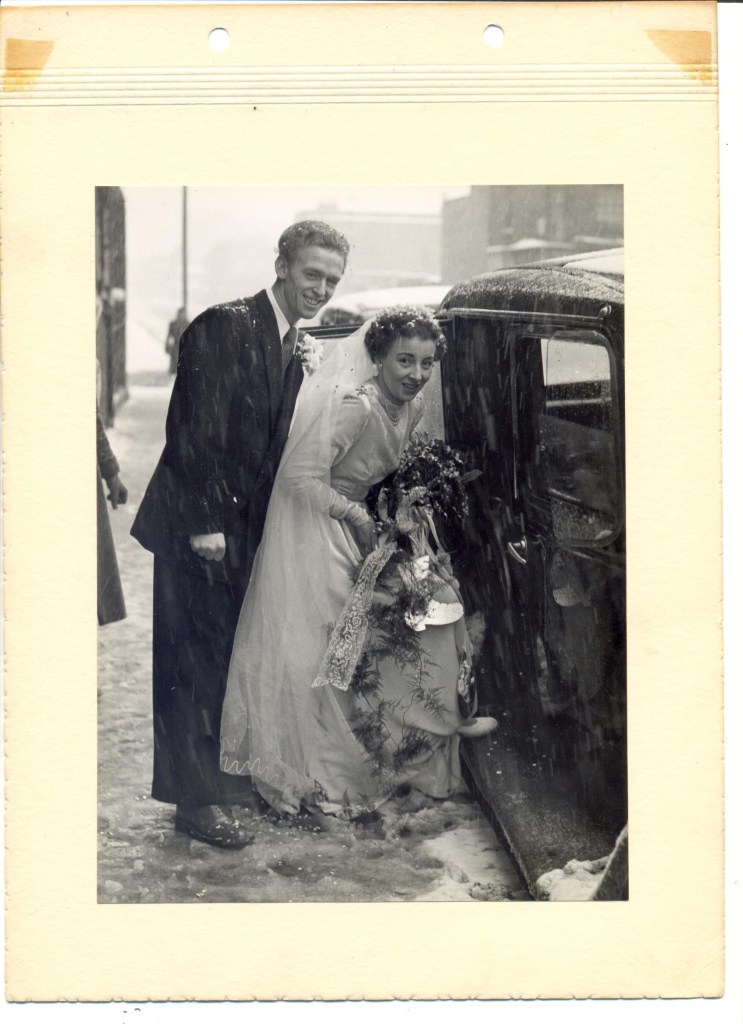
I don’t have any family wedding photos older than the 1950s. But here’s one of my Mum (Hannah and Fred’s youngest daughter) and Dad who got married in late March 1952. In the snow funnily enough …

Marie Mason and Stanley Charles Ball, The Church of Our lady of Seven Dolours, Peckham, South London 29 March 1952

In case you were wondering, there’s no legal reason why you can’t get married on Christmas Day nowadays. But no one really wants to because they don’t have to I suppose and most Churches are likely to tell you they are too busy (Register offices are not open so no Registrars available for other venues).

Anyway, Happy Christmas to anyone reading this. I shall be back with more stories in 2021.

A Bermondsey Life …

Elizabeth Regan (about 1859 – 1921)

Elizabeth was the youngest of the nine children I have so far found of Jeremiah Regan and Bridget Monahan who are one set of my maternal 3 x great grandparents. So, Elizabeth Regan was my maternal 3 x great Aunt.

Elizabeth had quite a life; she married three times, was widowed twice, separated from her second husband (it seems) may have left a child in the Workhouse and died in the Workhouse infirmiary.

A studio portrait of Elizabeth taken in, I suspect, the 1880s or 1890s

Elizabeth was born in Bermondsey in about 1859. She lived with her family until she married a John Butler Thomas in St Mary Magdalene Church, Bermondsey in March 1879.

John was 23 and working as a Lighterman on the river Thames. John came from Bermondsey too but in 1871 he had been working as a servant in a house in Bloomsbury, London.

John’s Father was a Lawyer rather than the more usual Labourers and Dock Workers that I’ve found in my research.

In 1870, John’s elder sister, Alice, had married one of Elizabeth Regan’s elder brothers, Timothy. So unusually, two sets of siblings from two separate families had married each other.

Witnesses at the Wedding were Cornelius Regan (another one of Elizabeth’s brothers) and Alice Regan, John’s sister, Alice Butler Thomas, who had married Elizabeth’s brother, Timothy Regan.

Elizabeth may well have met John through her brother’s marriage with John’s sister. Timothy Regan was also a Thames Lighterman and may have recommended John for employment in the Docks which was very much an industry where relatives were often brought in by existing employees to work there.

But tragedy was to strike Elizabeth and John less than a year into their marriage when, on 24th January 1880, on his 24th birthday, John Butler Thomas was killed in an accident while working on the Thames.

The Death Certificate explains that he “Drowned by falling from a barge. Under the water for four hours”. The accident was reported in the Lloyds of London Newspaper the next day, 

The outlined paragraph shown in the newspaper above, says the following,

LIGHTERMAN DROWNED ON HIS BIRTHDAY.  

A sad birthday fatality was reported to the Southwark Coroner by Mr Mummery, Officer for St Olave’s.  It appears that John Butler Thomas, living at 25 Thomas Street, a Lighterman by trade, was married but a few months since. Yesterday was his 24th birthday and it was intended to celebrate the event in a suitable manner in the course of the evening. Thomas, however, did not live to see the close of the day.  He left home as usual early in the morning and went to St George’s Terrace where he was to take charge of a barge belonging to Mr Tarnley. In attempting to push the barge from the river side to mid-stream, he slipped and fell into the water.  Efforts were made to rescue him but his body was not recovered for two hours when life was found to be extinct”

It makes me sad to think of this very ordinary family planning to celebrate John’s birthday only for him to die at work. It is particularly poignant since, three months after John died, Elizabeth gave birth to their daughter, Elizabeth, born in May 1880. 

After John’s death and daughter Elizabeth’s birth, Elizabeth Regan’s life seems to take a bit of a complicated turn.

By the time of the 1881 Census, taken on 3 April that year, so less than a year after Elizabeth had given birth to hers and John’s daughter, Elizabeth is living in lodgings and sharing them with two other women.  All three women describe themselves as Charwomen. The others are much older than Elizabeth. Elizabeth is described as the Head and the other two as lodgers. They all say they are Widows. There are, additionally, two other families living at the same address which made a total of thirteen people living in, what I suspect were, very cramped and unsanitary conditions.

I can find no trace of John and Elizabeth’s little daughter on the census for that year but I can find her death in 1887 aged just 7.

Elizabeth Butler Thomas’s Death Certificate aged just 7

Elizabeth Butler Thomas died from Potts Disease which is, apparently, a form of TB that occurs outside the lungs, usually in the vertebrae. TB can affect several tissues outside the lungs including the spine, so this was apparently a kind of tuberculous arthritis of the intervertebral joints. Little Elizabeth died in the St Olave’s Poor Law Union Infirmiary in Bermondsey

The Death Certificate says that the death of Elizabeth Butler Thomas (called Elizabeth Thomas on her death certificate) was registered by her mother who was present when the child died.  

But in the intervening time following Elizabeth Butler Thomas’s birth and death, Elizabeth Regan had in fact remarried and was now Elizabeth Waddington.

In the 19th century, it was very difficult for women to forge a successful single life. If they were widowed, women would be under pressure to remarry to have an income and someone to provide money for them to survive. Likewise, men who were widowed would need to remarry to have someone to look after their children. Although it was also common for widowed men with dependent children to distribute the children amongst relatives who would frequently, take them in.

So, in May 1882, Elizabeth had married a James Waddington, a Widower from Yorkshire, who was a Bricklayer. Their Marriage is in the same church as the one in which Elizabeth had married John Butler Thomas just three years earlier.

Elizabeth and James Waddington went on to have three children together (James’s children from his first marriage were taken in by relatives and never came to live with him and Elizabeth). I have no way of knowing whether Elizabeth and John Butler Thomas’s daughter lived with Elizabeth and her new husband. The fact that little Elizabeth died in the Workhouse infirmiary does not necessarily imply that she was living there, although she may have been. Many poor families used the Workhouse infirmary when they were ill because they could not afford to see a doctor.

In 1891, Elizabeth and James are living as a family with their three children in Bermondsey.

By the time of the 1901 census though, Elizabeth and James are living separately. James has gone back to Yorkhire where he came from originally and their eldest child has gone with him. Elizabeth is living with their two younger daughters and is again working as a Charwoman in Bermondsey.

Elizabeth is using the surname of Morris. This appears to pre-empt her third marriage to a William Morris in 1914 some 13 years later although on the 1911 Census, Elizabeth has reverted to Waddington. On that census, Elizabeth is living alone (both her girls married in 1909 – strangely, to two boys who lived next door to each other) and she is still working as a Charwoman.

Elizabeth married for the third time to William Morris, in October 1914, just a few months after the outbreak of WW1, at the Bermondsey Register Office. Elizabeth was 55. Her third husband was a Dock Worker but at the time of their marriage was serving as a Private in the 9th Cavalry Reserve Regiment and he was 11 years younger than her.

Elizabeth died in 1921 aged 61 from what appears to have been Acute Renal Failure, again in Bermondsey Workhouse Infirmary as had two of her brothers and her youngest daughter.

Her third husband, William Morris had pre-deceased her but I’m not sure exactly when. A niece of Elizabeth’s registered her death.

What a life Elizabeth had. Twists and turns amongst the poverty of south London. Three husbands, four children, disease, poverty, tragedy and the Workhouse. Tough times.