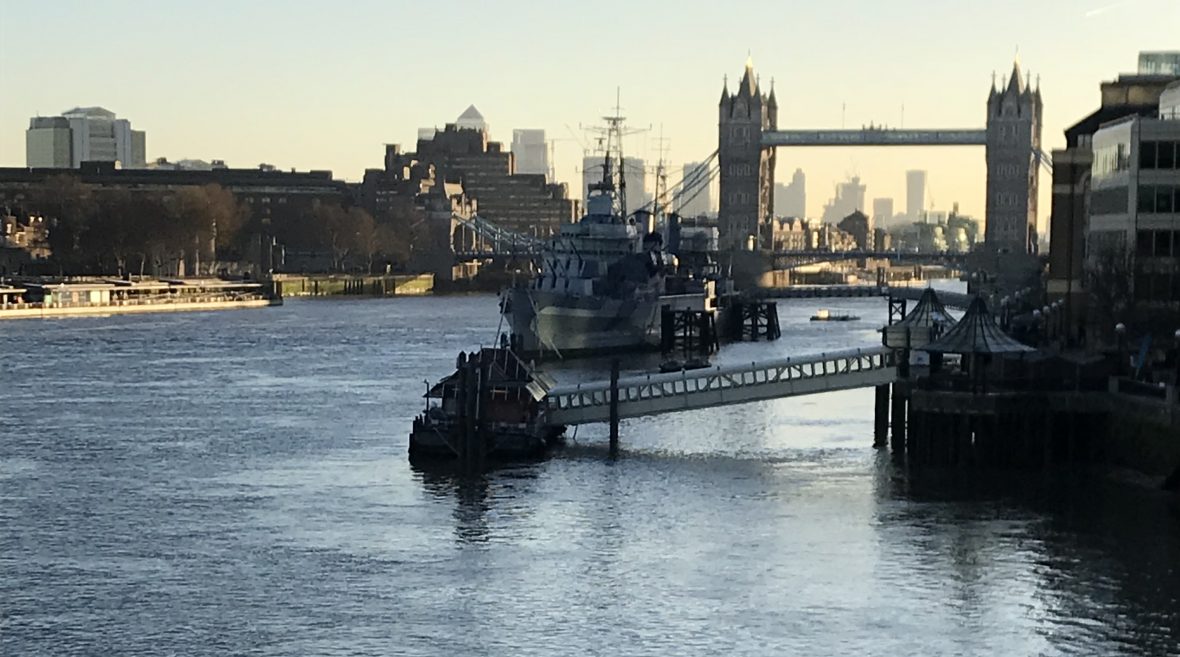
You never know where family history will take you do you? I certainly never thought mine would take me to the Channel Island of Jersey and a tale of second marriages, an heiress and German War Records. But it has.
To put you in the picture. I got interested in one of my (it has to be said fairly distant) relatives when I found him heading to Australia to emigrate with his first wife when they were in their 60s. Seemed unusual. So I did a bit of digging. As you do …
Thomas Knight Ball (1858 – 1948) and I have a very distant connection. One of my paternal 4xGreat Grandfathers was Thomas Knight Ball’s 2x Great Grandfather. That makes him my 2nd cousin 3 times removed. I said it was distant … stick with me.
Thomas was born in Euston Square in the North West of central London to parents Thomas Oram Ball and Jane Knight in June 1858. His middle name follows the naming convention that the Victorians rather liked of giving children (particularly the eldest one which Thomas was) the mother’s family name as the child’s middle name (and very glad modern day family historians are for this given it often helps find and validate birth and other records).
Thomas’s father worked on the railways and the family always lived near a mainline station in central London (St Pancras, Cannon Street and in 1858, Euston) to the north of the river Thames. In Victorian times, railway building and expansion was key to make travel more accessible to everyone and the railway companies were major employers.
Thomas’s childhood appears to have been unremarkable and by the time of the 1881 census, when he was 23, Thomas is working as a Grocer’s Assistant in Old Bond Street, Westminster when he lived in a Boarding House for the grocer’s shop staff.
Thomas married Emma Auber at Falkland Road Wesleyan Methodist Chapel in St Pancras, London in 1882. They were both 24. Both living in Kentish Town. Thomas now gives his occupation as a Clerk.
Thomas and Emma continued to live in London until the 1901 census when they have moved to Brighton in East Sussex. But by 1911 at the time of the next census, they are back living in London. This time across the Thames in Brixton in the South West of the city. They have no children and are both 52.
13 years later, in September 1924, Thomas and Emma set off on the SS Ballarat bound for Melbourne, Australia. The passenger list says Australia is their “Future Permanent Address”. Just one year later however, they return to England stating that Kinninghall Road in Clapton, East London is to be their permanent residence. Thomas is described as a Farmer. Did they try their hand at farming in Australia I wonder and it didn’t work out? Did they get homesick? Or perhaps Emma was unwell and they wanted to come home. Sadly, Emma died from a heart condition a couple of years later. By this time though, they were back living in Sussex; this time in Worthing.
But it is after Emma died that Thomas’s life really gets interesting.
So having upped and gone to chance a new life in Australia at the age of 65 and returned less than a year after he sailed there with Emma, and following Emma’s death, Thomas seems to embark on a new life. Much travelling, some with his brother, Francis, and then on to a new marriage to a woman much younger than him. Sigh. It was ever thus. But read on …
Less than three months after Emma has died, Thomas can be found coming back from Durban in South Africa on the same ship (the SS Edinburgh Castle) as his younger brother Francis. By this time, Thomas was 68 and Francis, 65. They embarked at Natal and disembarked at Southampton. Both give addresses in Worthing as their proposed permanent residence. They travelled in 3rd Class.
Then, four months later, Thomas and Francis are shown on a passenger manifest coming back from Montréal, Quebec in Canada. They embarked in Quebec and disembarked in Liverpool on the SS Doric. They travelled in what is described as a “Tourist Cabin”. Thomas is 69 by now.
Then at the end of 1927, Thomas remarries. He is 69 and described as a Widower. Lily Mabel Thatcher, Thomas’s new wife, is 38 and a Spinster. She comes from Jersey in the Channel Islands.
Now, I can hear the wheels turning in your head. Young woman. Older man (31 years older to be clear …). A gold digger for sure. Well, think again, dear reader. Lily is single, comes from Jersey, a place known for its substantial economic wealth and high net worth individuals even in the 1920s and 1930s. Thomas has come from very ordinary stock and is travelling the World in Steerage. Who is digging gold you may wonder.
Lily Mabel Thatcher (1889-1977)
Lily is intriguing. A bit of an enigma. I wish I’d known her.
Lily Mabel Thatcher was born on 23 April 1889 in St Helier in the channel Island of Jersey to parents John Charles Thatcher and Jane Ann Lawrens. John was a self made, very successful businessman and owned the island’s biggest painting and decorating company. Jane was from a very old, established Jersey family.
Lily was the youngest of of John and Jane’s four children. Lily had two older brothers, Charles and Reuben and a sister, Ida. Ida died aged 14 in 1899, from Meningitis.
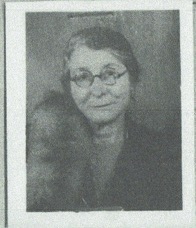
Lily Mabel Thatcher, about 1940
Lily lived at home with her parents and family until at least the 1921 Census taken in June of that year
Lily’s father died in January 1922 and left his entire estate (I suspect a substantial one) to his wife, Jane Lawrens.
In August 1922, aged 33 and unmarried, Lily leaves Jersey and sails from Southampton to Montrèal on the SS Andania. She is travelling with a Mrs Violet Chapman, aged 34 and described as a housewife of St Helier, Jersey and her 4 year old daughter, Pearl. Lily gives the same address as Mrs Chapman and Pearl in Jersey. The Arrivals Form in Canada says that Lily is single, has £5 on her, is in Canada with Mrs Chapman on holiday and they are both destined for 592, Union Avenue, Montrèal.
On 5 January 1923, Lily comes back from Canada on the SS Minnedosa which departed St John’s, New Brunswick, Canada for Southampton on that date. Lily gives her mother’s address as the one to which she is going to live in St Helier.
I cannot find Mrs Chapman or her daughter on the passenger list but she is to be found coming and going frequently and regularly between the UK and Canada variously to Montreal or St John’s in the years after Lily left and on one passenger list Violet Chapman gives her last country of domicile as Canada. Intriguing but not relevant to our story.
In 1924, Lily’s mother died. Jane Lawrens leaves the house in which she is living jointly to Lily and her younger brother Reuben. Various other items of furniture are left also to Reuben. Jane’s eldest son Charles is the Executor of Jane’s Will and received a tea service (a Japanese tea service to be precise). The remainder of Jane’s estate (the bulk of which was presumably what she was left by her husband two years previously) Jane leaves to Lily.
This is the first in a series of bequests Lily receives from her family.
Then sometime during these years, Lily somehow meets Thomas (I would lay money on it that they met on a ship but I have absolutely no evidence to corroborate this). They marry in 1927 in Worthing where Thomas had lived with his first wife. Both in fact giver their address as the house in which Thomas lived with Emma and where Emma died. The marriage takes place in a Baptist Chapel and the witnesses were Thomas’s brother, Francis and Lily’s younger brother, Reuben.
During the 1930s there are various records of Thomas and Lily travelling by ship to some fairly exotic destinations. In 1934, they are sailing from Liverpool on the SS Ulysses bound for what seems to be a cruise that goes via Marseilles, Port Said, Colombo, Penang, Singapore, Java, “Australian Ports” and returns to the UK via South Africa before docking finally in London. Both give their address as Jersey in the Channel Islands. Thomas is 75 and Lily 45. There is a record of them coming back from Indonesia on the Ulysses in January 1935, presumably the same trip.
On the passenger manifest, Thomas and Lily give their address in Jersey as a house called “Karersee” in Samares, one of the twelve Parishes of Jersey, located on the South East coast.
I have been to look at the house. It is a fairly unremarkable but substantial house near to the main coastal road. I imagine the house has been updated since the 1930s but it is still interesting to see it I think
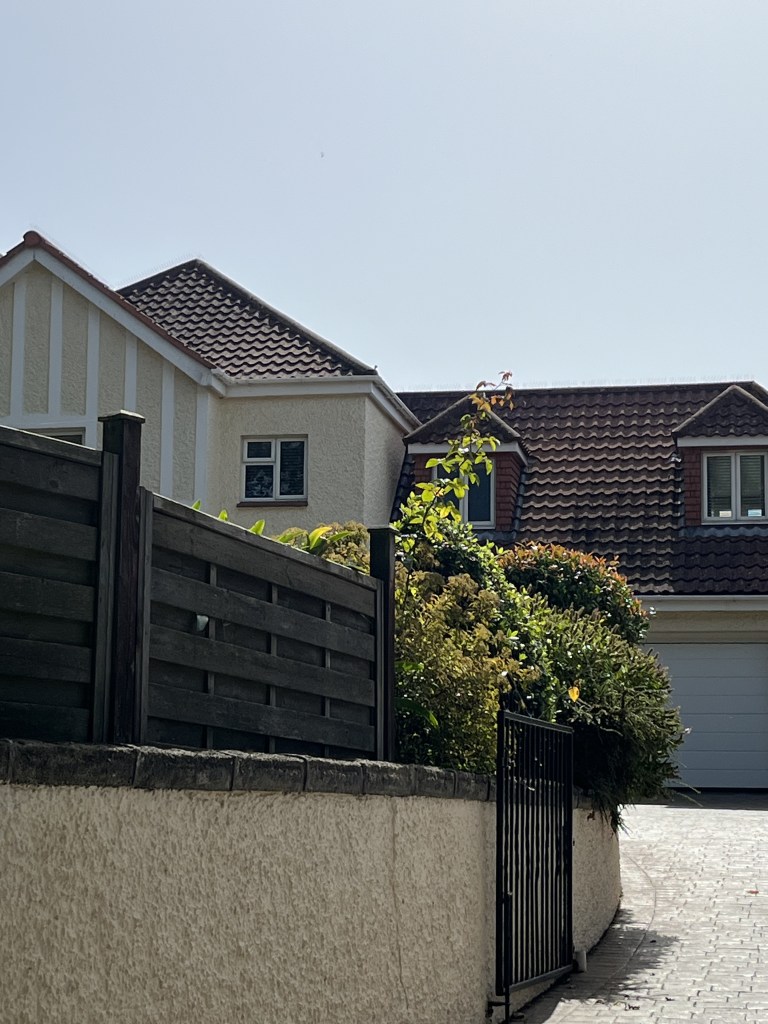
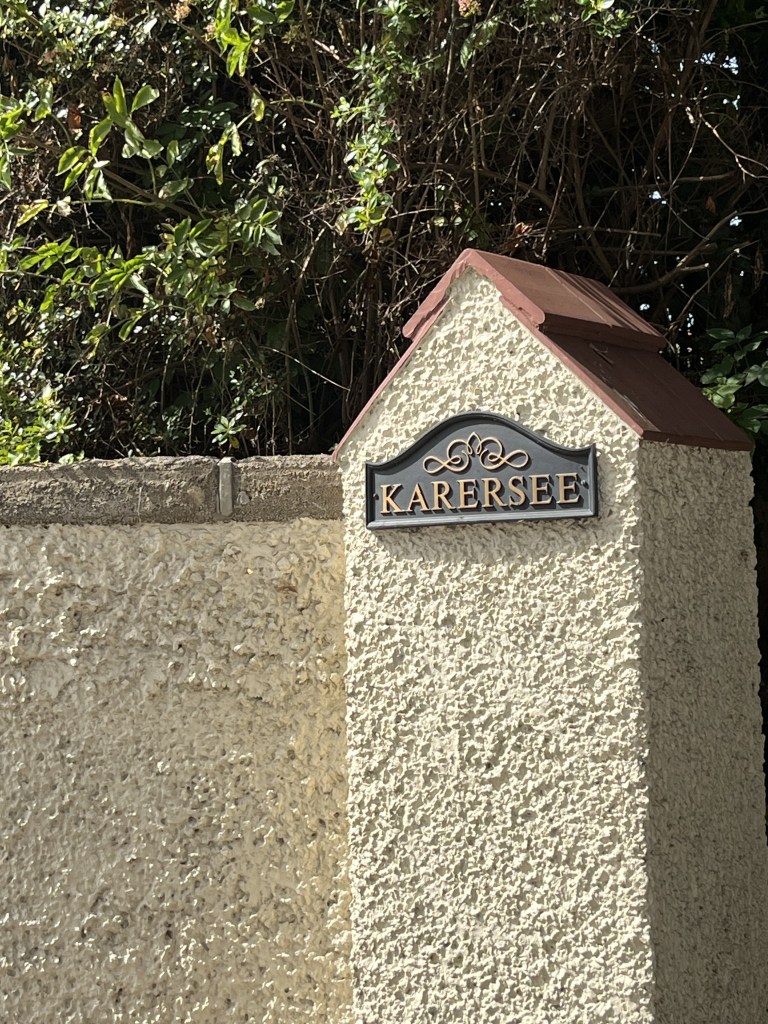
“Karersee”, Samares, Jersey, CI Home of Thomas and Lily
The only reference I can find to the name Karersee is Lago di Carezza in the Italian South Tyrol in a place called Trentino which an autonomous province in the north east of Italy. In German it is known as Lake Karersee. In English, the Rainbow Lake. It looks beautiful. I’d like to think someone name this lovely house on Jersey after that lake. I’d also like to think it was Lily and Thomas ❤️ …
The Channel Islands are a self-governing parliamentary democracy under the constitutional Monarchy of the Crown of Great Britain. The Channel Islands are not part of the United Kingdom but are known as one of the “British Islands”. They have their own financial, legal and judicial systems and the right to self determination. As such the islands are reigned over by the British Monarch, currently King Charles III. There is a Lieutenant Governor resident on Jersey who acts as a link to the Monarch but the Channel Islands are entirely self governing.
On 1 July 1940 the islands were the first and only part of Great Britain to be invaded and occupied by the German forces during the Second World War. The occupation lasted almost 5 years until 9 May 1945 when the Germans surrendered and the islands were liberated.
This occupation has led to the Channel Islands having very different records during this time from other parts of Great Britain and the United Kingdom. Primary of these (and of most use to family historians) is the identity cards all citizens were required to have by the occupying Forces.
The Jersey Archives have digitised these records and a lot of others created because of the very difficult circumstances in which the island found itself in 1940-45.
Each identity card had personal details of the Channel Islands’ citizen plus (in most cases) an up to date photo. This is Lily’s (I do love the way she has included the addition of her fur stole just thrown over her shoulder and don’t you think her eyes just look super defiant behind those glasses?).
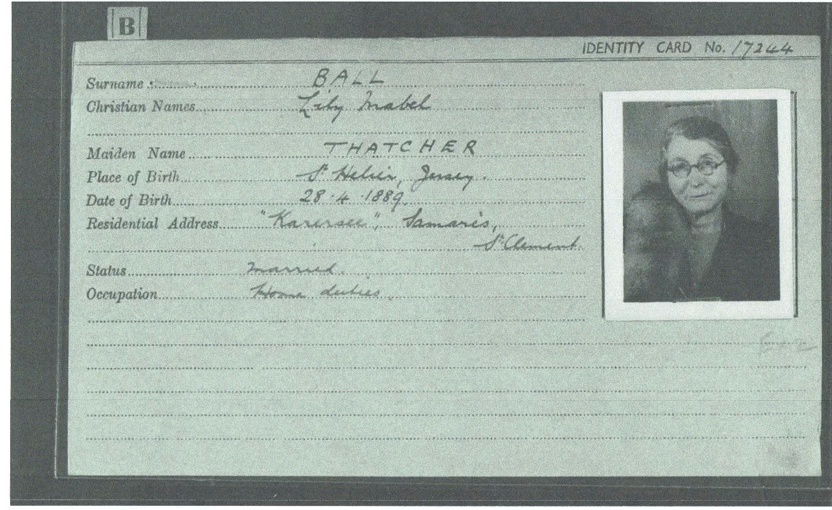
This is the form that was completed for Lily in order to have her card issued. She had “brown hair with some white” she says and brown eyes. The eagle eyed amongst you will notice that her date of birth is slightly different from the one I’ve used from her birth and baptism record but these were difficult times and which of us could say we could remember our birthday when faced with an invading army?

Thomas’s registration card has no photograph (it says he is exempt from giving a photo but I can’t read why). I’ve included below his registration form and card.
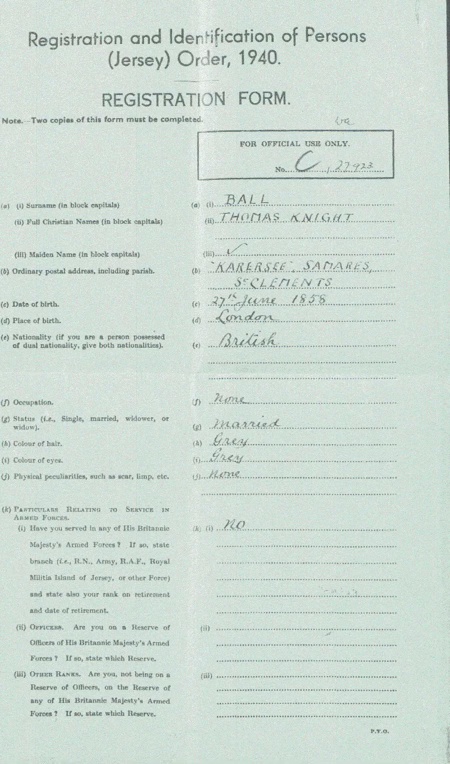
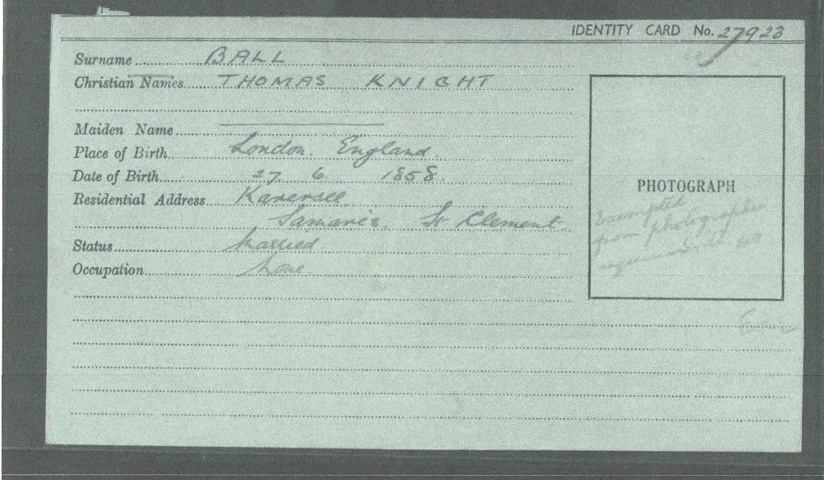
Thomas says he has grey hair and grey eyes. At the time of the occupation of the Channel Islands, Thomas was 82 and Lily was 51. Not the final years of their relationship they would have chosen I imagine.
Three years after WW2 ended, Thomas died on 16 February 1948 aged 89.
Thomas had made his Will 16 years earlier, in 1932. Thomas leaves everything to his wife, Lily with the caveat that, should she predecease him, everything is to go to her brother, Reuben. Thomas makes it clear in his Will that has “abandoned” his domicile of origin and intends to live the rest of his life in Jersey.
Whilst I don’t doubt that Thomas’s estate was inferior to Lily’s there was presumably some residual benefit that Lily received.
Birth, marriage and death events are recorded differently in Jersey from the remainder of Great Britain. I have validated Thomas’s death from his funeral and burial records. In Jersey, records of burials and cremations are far more detailed and extensive and as such contain a lot of useful information. so while I don’t know what Thomas died from, I do know that his funeral was carried out at St Luke’s Church by the Reverend Pawson (who charged £10 for his services) and that the funeral cost 40 pounds 3 shillings and 6 pence (younger readers please look this ancient form of currency up here https://www.royalmintmuseum.org.uk/learning/learning-zone/going-decimal/old-money/) and the Funeral Director’s bill was settled in March 1948 by Lily. Exactly where the Church is is obscured by an annoying ink blob on the original record , but to this day there is a St Luke’s Church in St Saviour’s Parish which borders St Clement’s Parish and is just to its north so I’m going for that one.
The Jersey Archives’ Burial Records give me Thomas’s exact date of death and his place of burial. Thomas died on 16 February 1948 aged 89 and was buried in Mont à l’Abbé Cemetery in St Helier two days later.
Mont à l’Abbé Cemetery is a vast cemetery in the capital of Jersey (and indeed the capital of all the Channel Islands). Thomas and Lily are buried together there (spoiler alert – Lily does die but not for a while …) in the Thatcher family plot. But that’s all for Part 2.
Thank you for reading. I promise to be back very soon with the next instalment …
 Linda Swinburne Family History Blog