Albert Valentine Barkel

It all started by chance. Probably that’s the best way for intriguing tales to start.

As well as my own research, I also sometimes do it for other people. The Barkel family is for my lovely Mother-in-law born Margaret Barkel Lilley. Margaret Swinburne since 1950, is still dispensing wisdom at 97 and is a rich source of information for her family with her sharp and insightful mind and a memory as sharp as a steel trap.

Margaret’s family come from the North East of England. Mining stock. Hand to mouth existence. Poverty. Hard back breaking work. Small cramped houses. Tight communities all looking out for one another. Margaret remembers that. Margaret lived that. One day I’ll write Margaret’s story but today it’s her 2nd cousin, Albert Valentine Barkel.

Margaret is still in touch with an ever diminishing family circle back in the North East. One day, during a phone call, one of her relatives said she had seen a name that had caught her eye on a Memorial Board for those who had fought and died in both World wars in a local church in the North East and wondered if he was a relative.

The Board was in St Paul’s Church in Ryhope. Ryhope was once a small pit village to the south of the city of Sunderland in Tyne and Wear. Nowadays it feels like it’s just one of a number of suburbs of Sunderland and kind of morphs into the city.

The name was Albert Valentine Barkel and Margaret assured her relative that “our Lin” (that’s me) would find out.

So I did. And a gem of a story it turns out to be …

Albert was born in San Francisco, California, USA on 14 February 1912 (well, there’s the answer to his unusual middle name, right there). I will admit, the place of his birth was a bit of a surprise but this is how it came to be.

Albert’s parents were Thomas Deaton Barkel (1888-1971) and Hilda Alice Cowley (1886-1928). Thomas was born in Ryhope, then a small mining village in County Durham and Hilda at a nearby village called Milfield.  Thomas and Hilda married in the Summer of 1906 in Durham. 

Life then seems to have taken a downward turn very quickly for Thomas and Hilda though when, later in 1906, Thomas was tried with two others for the manslaughter of a man called McDonald Dumon in Durham.  Thomas was working in a Bar at the time so maybe a pub brawl that got out of hand.  Thomas and his co-defendants were acquitted. 

In December 1906, Thomas and Hilda had their first child. A son, called Albert after his paternal Grandfather, born in December (so Hilda would have been pregnant when they married). But little Albert died soon after he was born. 

Next, in 1908, they had a daughter, Annie, named after her paternal Grandmother and in 1909, they have another son, called Thomas Deaton Barkel after his Father. Happily, Annie and Thomas junior survived.

On the census of 1911 which was taken at the beginning of April that year, Thomas senior was working as a Coal Miner in the Ryhope Colliery and Thomas, Hilda and their son are living at 18, St Paul’s Terrace in Ryhope.

Their daughter, Annie, however now aged 3 was living nearby with Thomas’s parents, Albert Barkel and Annie Forster.

But, later that year, Thomas and Hilda went on a grand adventure when they left County Durham and boarded the SS Celtic in Liverpool, bound for New York city in America. They only took their son, Thomas, however and little Annie stayed with her paternal Grandparents.

Thomas, Hilda and Thomas jnr arrived at Ellis Island in in the shadow of the Statue of Liberty on 21 October 1911 presumably in the hope of making their fortune like so many others around that time.

The passenger manifest records that Thomas was 23, had dark hair and grey eyes; was 5 feet 7 and a half inches tall and had a dark complexion. The contact in the country Thomas and Hilda had left  (called the “Old Country” on the US immigration form) was given as Albert Barkel (Thomas’s father) who lived at 14, Thomas Street, Ryhope. 

Thomas said that he and his little family were bound for San Francisco, California and the record states that Thomas had £150 in cash on him (quite a lot of money in 1911).

How they came to be making this journey will no doubt remain a mystery.  It is as baffling as it is exciting. Ryhope was a very small place at that time (and for a long time afterwards). The only thing people did in the village was work in the local coal mine and go to Chapel on a Sunday (sometimes twice). Everyone knew everyone. Just what preceded Thomas and Hilda’s decision to set out from North East England not only to the USA, but not to stop at the East coast there like so many did, but to continue to travel West and go all the way to California.  

But go to San Francisco they did. And they made a life there including having their next son, Albert Valentine in February the next year (so Hilda must have been pregnant when they set off from England).

After 6 years, Thomas, Hilda and their eldest son became US citizens via the US Naturalisation process in December 1917. Albert already was a citizen by virtue of being born in the US.

That same year, Thomas Snr was drafted into the US Forces (to serve in WW1 presumably but there are no records I can find to show whether he actually went to fight).

On the US Census of 1920, taken on 1 January 1920, Thomas, Hilda and their two sons are living at 1822, West 29th Street, San Francisco, California, US. Thomas is working as a Storage Man at an Ice Cream Factory and Hilda is working at the same place as a “Wrapper”. 

In April 1920, Thomas and Hilda apply for and are granted US passports.

They have now been in the US for 9 years. They have a house, jobs, two sons, they are all US citizens. Thomas has even served in the US military.

And yet just two months after they get their US passports, Thomas, Hilda and their two boys board the SS Imperator of the Cunard White Star Line and come back to England where they land at Southampton on 26 June 1920.

What made them leave, I wonder? I could conclude they only got the passports to travel back to England.  But when they got there it doesn’t seem as if they had made their fortune and had come home to set up a(nother) new life because, the next thing I can find is Thomas, Hilda and their two sons on the 1921 UK Census taken in June 1921 so about a year after they came back to England when the Census return shows that they are living with Thomas’s parents, Albert Barkel (1865 – 1951) and Annie Forster (b 1869) at 40, Thomas Street, Ryhope. 

Albert was a Time Checker at the coal mine in Ryhope and Annie a housewife. Thomas and Hilda’s daughter Annie is still there, now described as an adopted daughter and now aged 13. Annie Forster’s parents a Thomas D Forster who is a retired Coal Miner formerly working in the mine at Ryhope and  his wife Emma are also living at the address. They are aged 74 and 72 respectively.

The houses in Thomas Street are not large. Never have been. And there were 7 adults and two children living in number 40. That would seem to underpin my view that Thomas had not come home with a heap of money.

Thomas is now working as an Attendant at the local Mental Hospital, Cherry Knowle, and Hilda is a Housewife. Their two boys now aged 11 and 9 are at school. 

Then 7 years later, Hilda died aged just 42 in 1928 and in 1929, Thomas married a Frances Ward (1891 – 1980) in Sunderland.

On the 1939 Register, Thomas, Frances and son Albert Valentine are living at 12, Stockton Road, Ryhope, Sunderland. Thomas is now described as a Male Nurse at Cherry Knowle and is also an ARP Warden. Albert Valentine is an Acountancy Clerk.

Thomas lived to be 83 and died in Sunderland in 1971. Frances died in 1980 aged 88.

Thomas and Hilda’s eldest son, Thomas Deaton Barkel jnr married a Violet Sedgewick in 1929, became a Police Officer and died in 1980.

I cannot find anything out about their daughter Annie after the 1921 census.

Albert Valentine Barkel, Thomas and Hilda’s youngest son,  married a Beatrice McMullan in 1941 and joined the RAF Reserve, serving in Bomber Command where he achieved the rank of Flight Sergeant and was posted to RAF Wymeswold in Leicestershire. 

On 7 October 1942, Albert and two colleagues were taking part in a training flight. Albert was the Navigator and the plane they were flying was a Vickers Wellington Bomber, designed in the mid 1930s specifically to carry out medium to long range bombing missions.

At 16.08 that day, the plane was seen jettisoning fuel just before it crashed at Woodhouse Eaves, 3 miles south of Loughborough.

All 3 men on board were killed.  Albert who was 30 plus Warrant Officer Donald Anthony Gee and Flight Sergeant Leslie Jones who were both 22.

Albert is buried in Sunderland Cemetery in Ryhope Road, County Durham and his grave is provided and maintained by the Commonwealth War Graves Commission.

The inscription on his grave reads “In Proud Remembrance of my Husband”.
The National Probate Register records that Albert left £164 12s 4d to his wife, Beatrice, who lived at 32, Waldon Avenue, Ryhope, County Durham.

Albert’s name is included in the memorial in St Paul’s Church, Ryhope commemorating those from the area who died in WW2.

The Jersey Connection Part II

I want to tell you a bit about Lily’s family. The Thatchers. And to finish Lily’s story. But first a cemetery.

My family research has generally revealed poverty. My forebears lived in dirty, damp conditions, engaged in hard, manual work. Generally living hand to mouth, day by day. When they died, they were buried in unmarked, public graves. No headstone. No memorial. After 50 years or so, the land in which they were buried, reverted to public ownership and someone else was buried there.

Rarely have I found a headstone or memorial in existence.

But not the Thatchers. There is a family plot in Mont à l’Abbé cemetery in St Helier in Jersey for all of them. And headstones. All of them together. With marked graves. It is simply a family historian’s joy to find such things (Reader – wrong word to use about death I appreciate but you know what I mean I’m sure …)

Mont a l’Abbé cemetery is in two parts. The first was opened in 1855 (known as the Old Cemetery) with the “New” part being added in 1881. It is a vast and very peaceful place which is high up and overlooking the sea in St Helier. Plots are divided into four (north and south 1 and 2). The Thatcher family has one whole plot.

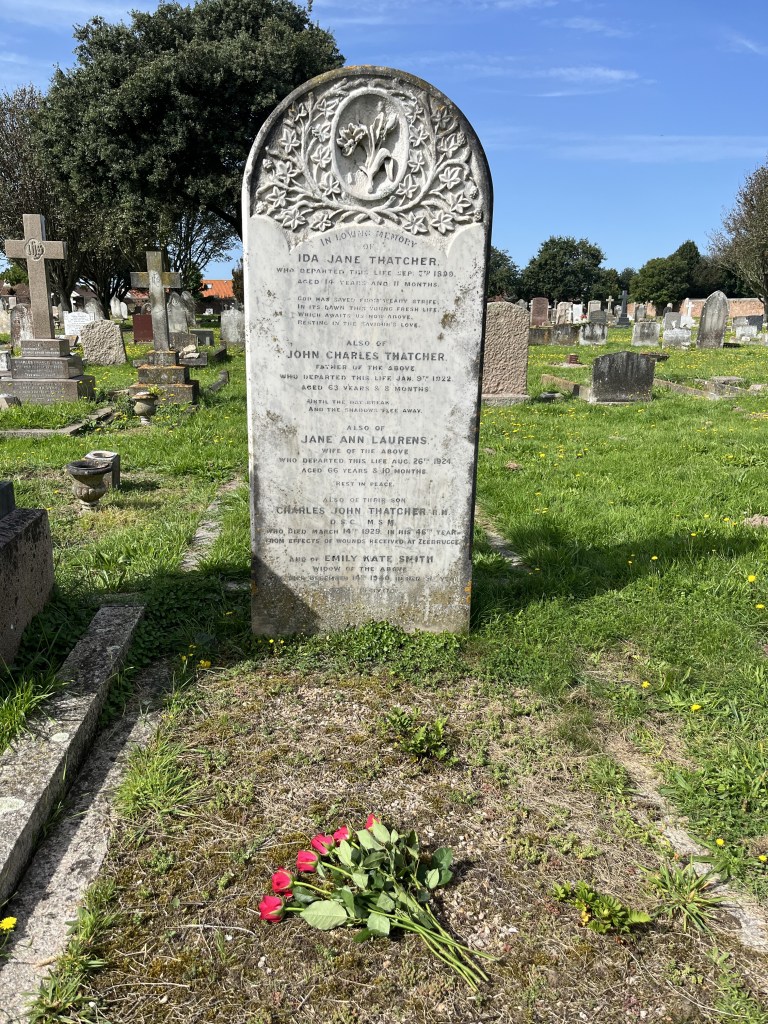
Ida Thatcher was the first to be buried there in one of the graves on what is actually the East side of the plot (despite them being described as north and south) side of the plot. As I said in Part I, Ida died aged 14 in 1899 from Meningitis.

Also on this side is John Charles Thatcher, Lily’s father (and Ida’s of course) who died in 1922. Next Jane Ann Lawrens (sometimes spelt Laurens as you can see) , their mother and John’s wife, in 1924. And here they are.

You will see too, that there are two other burials on this side of the plot. Charles John Thatcher and Emily Kate Smith.

Charles John Thatcher (1883-1929)

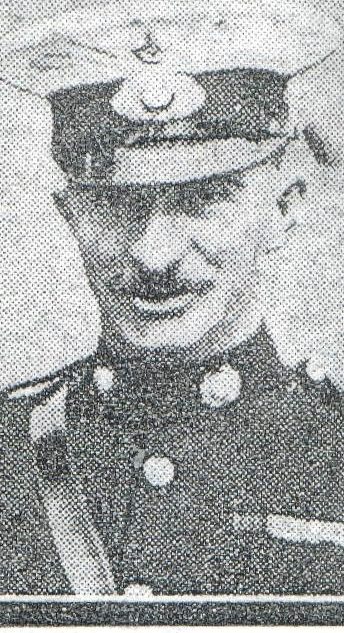
Charles John Thatcher (1883-1929) was the Thatchers first born child and Lily’s eldest brother. Charles joined the Royal Marines in 1900 when he was only 17 (he gives his age as 18). Charles signed up in Portsmouth to the Royal Marines Light Infantry (RMLI) and went on to have a long and distinguished career of military service which ended after 22 years (and of course spans World War I) when he was “retired” in 1922. Charles achieved the rank of Regimental Sergeant Major and was awarded the Victoria Cross, the Distinguished Service Medal and Distinguished Service Cross in 1918. In addition, Charles’s record confirms the award of the Meritorious Service Medal which was given to senior non commissioned officers for long and/or distinguished military service. 

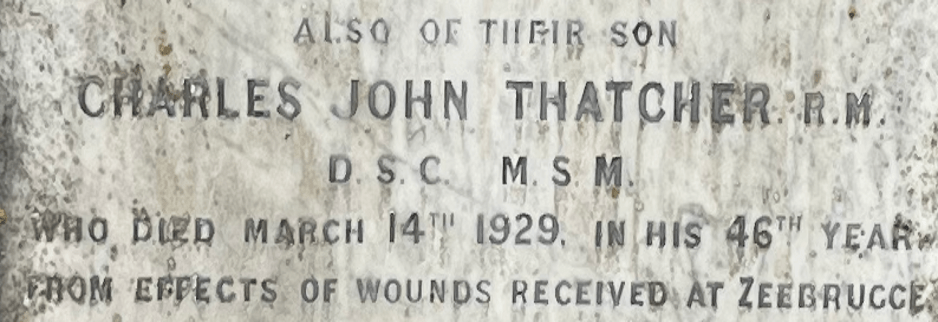
This is a magnified copy of the inscription on Charles’s gravestone where it attributes his death to wounds received in the battle of Zeebrugge in WW1.

The Zeebrugge battle was fought in April 1918 when the British Navy attempted to stop German ships and U-boats from using Zeebrugge as a base from which to launch a raid on England.  It was led by the 4th Battalion Royal Marines and the warships HMS Vindictive and Invincible.  Charles’s record indicates he served on Vindictive in 1912 but in this campaign he was apparently on the Invincible.

If you’d like to know more about the Zeebrugge raid, this link will take you to a full account  https://www.cwgc.org/our-work/blog/the-zeebrugge-raid-at-105-the-trials-tragedy-of-a-daring-amphibious-assault/

Charles was mentioned in despatches as follows “ Sergt.-Maj. Charles John Thatcher, R.M.L.I. was mainly instrumental in conveying the heavy scaling ladders from the ship [Invincible] to the Mole [The Zeebrugge mole was a mile-long seawall jutting out into the North Sea upon which several German sea-facing artillery guns were placed and had to be taken out for the plan to be a success. It was also studded with concrete machine gun posts] and throughout the operation displayed great coolness and devotion to duty” for which he was awarded the Distinguished Service Cross. I cannot find mention of Charles amongst the injured but when he died 11 years later several regional newspapers reported his death as a “Hero of Zeebrugge” and all the reports mention that Charles was severely wounded and gassed. 

Charles was awarded the Victoria Cross for “Operations Against Zeebrugge and Ostend on the night of 22nd to 23rd April 1918” according to his Military Record and a report in the London Gazette in July that year.

Charles died in March 1929, aged 46. His Death Certificate says he died from Pulmonary Tuberculosis and Asthenia (generalised weakness or lack of strength). Charles’s family had inscribed on his gravestone that he died “from effects of wounds received at Zeebrugge”. Whether, in fact, cause and effect were ever established though is not clear.

However Charles does not have a Commonwealth War Grave. The Commonwealth War Graves Commission (CWGC) is very thorough in this respect and will ensure service personnel have a CWG memorial stone even if they died long after wounds or injuries received in conflicts if their death can be directly attributed to them, so it would be easy to conclude that this inscription is not necessarily accurate.

So I wrote to the CWCG. I explained what I had discovered and whilst I have not been successful at establishing either the veracity of the view that Charles died as a result of effect of his being gassed in WW1, nor of getting a CWG memorial for him, I did receive this rather lovely reply to my enquiry.

Unfortunately the Commission’s remit is limited to those who died within our qualifying date period for both the First and the Second World War. Rather than being an arbitrary date, 31 August 1921 is when the Act of Parliament was passed which formally brought the First World War to a conclusion, hence is used to define those who died during the war years.

I’m afraid that as this individual died in 1929, so after August 1921, he therefore falls outside of our Royal Charter responsibilities. There is no provision for us to make exceptions, even in cases where there is evidence that a post-1921 death was attributable to wartime service. Sadly many men died in the years immediately following the war and in the subsequent decades – some but not all will have been either directly or indirectly a consequence of wartime military service.  

Whilst understanding that this outcome may represent a disappointment, equally, we hope you can understand the need to apply our Eligibility Criteria consistently. That this individual is not considered a Commonwealth war casualty within the remit of the Commission in no way diminishes the sacrifices made, nor the tragedy that his family had to cope with. We’re glad that through your efforts, Sgt Major Thatcher continues to be remembered.

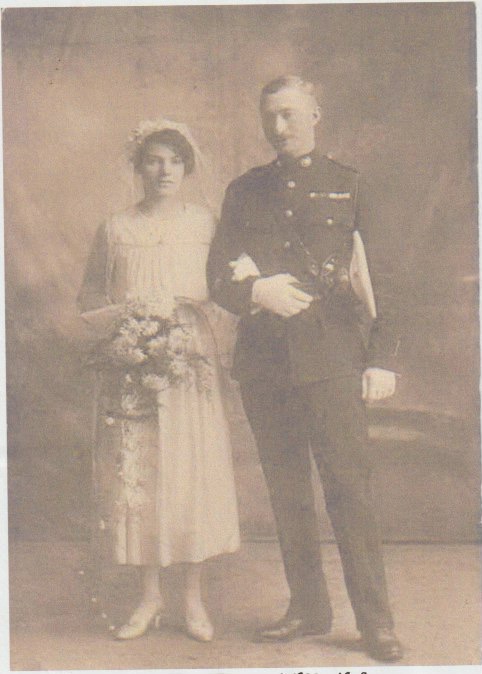
The final commemoration on this side of the Thatcher plot is that of Emily Kate Smith (1890-1940). Emily was Charles Thatcher’s wife and they were married in September 1918 at the Royal Marines’ Barracks in Alverstoke in Hampshire by the Royal Marines’ Military Chaplain.

Charles John Thatcher and Emily Kate Smith on their wedding day in 1918

Emily was born in Crawley in West Sussex in 1890. When she and Charles married in 1918, Emily gives her address as Cowes on the Isle of Wight. In 1921 they are living in Military Barracks in Gosport in Hampshire. Lily, Charles’s sister, was one of the Witnesses.

Emily was the sole recipient of her husband’s estate when he died at which time they were both living on Jersey. They had no children. Emily died in 1940 aged just 50 from Colon Cancer.

Emily’s Will is curious. Emily leaves her entire estate to an Alison Eleanor Coffin who was only 13 when Emily died. The Will notes that Alison is the daughter of a René Armand Coffin to whom the estate would have gone if Alison were to be deceased when Emily died. Emily’s Will was made just 6 months before she died.

So now I’m curious about the Coffin family of Jersey. I want to know what René and his daughter’s connection was to Emily Smith and why she chose to leave her entire estate to this child. That’s how genealogists get distracted …

Reuben Lawrence Thatcher (1887-1969) was Lily’s younger brother; only two years separated them. Reuben never married. Reuben worked in his Father’s painting and decorating business and from trade records over the years, I could deduce that he took over management of the business after his Father died.

Reuben served in WW1 in both the Royal Defence Corps and the Honourable Artillery Company. Reuben was discharged from the Army in 1918 after being gassed.

Reuben receives half of his Mother’s house in 1924 when Jane Lawrens died (Lily having received the other half). Reuben also receives various bequests of furniture and ornaments from Jane.

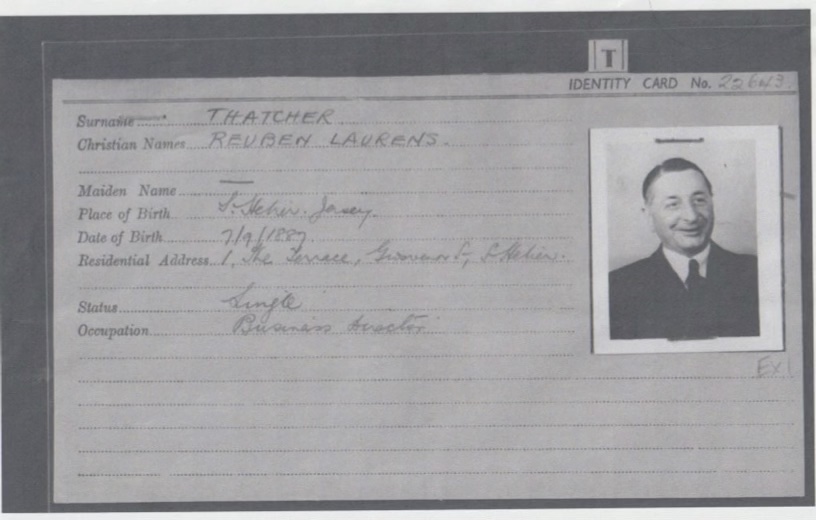
Reuben was living on Jersey during WW2 and thus also had a Registration card like Lily and Thomas.

Reuben Lawrens Thatcher WW2 Registration Card

Have you ever seen a happier face being presented to a hostile, occupying military force?

Like Lily, Reuben loved to travel and during the 1950s can be found on various ships’ passenger lists to and from the UK going to Buenos Aires, Canada, and extensively in the Far East including Yokohama in Japan.

Reuben died in 1968 aged 81. His Will is comprehensive.  Probate records show his estate as being worth £42k (worth about £624k now). I think where he died (The Limes, Green St., St Helier) was a nursing and residential care facility for older people.

Reuben’s burial record shows his funeral was held at St Helier Parish Church on Thursday 2 January 1969.  Reuben was cremated and his ashes are buried at Mont-a-l’Abbé cemetery in the Thatcher family plot and commemorated on the same stone as Lily, his sister and Thomas her husband.

Reuben left the individual bequests of between £100 and £250 each to Charity and good causes with some personal bequests to individuals. These are detailed on his Will as follows

  • Jersey Blind Society
  • Brig-y-Don Children’s Convalescent Holiday Home, Jersey
  • Jersey Masonic Temple
  • Eunice Callas de Caen wife of Francis de Boutillier of Highfields, St Ouen, Jersey
  • Christopher Le Boutillier grandson of Francis Le Boutillier
  • John Wilcox son of John T.A. Willcox
  • Jane Wilcox, daughter of John T.A. Wilcox
  • Mary Wilcox
  • Sarah Wilcox

– The last four above named to receive all Reuben’s books, prints and pictures

  • Richard Loughlin, Head Steward the United Club, St Helier, Jersey
  • Philip Edgar Le Couteur, 6, Rouge Bouillon, Jersey
  • Walter F Thatcher, The Follies, Pontiac Common, Jersey [presumably a paternal relative]
  • Fred Percy Tastevin, Avenue House, West Park, Jersey
  • Remainder to Lily, his sister

Should Lily have predeceased him (she didn’t) there were further instructions about how her share should also be divided between charities.

So this is a further bequest that went to Lily in addition to the one from her mother and from her husband.

And finally to finish Lily Mabel Thatcher’s story.

In Part I, we left Lily just after her husband, Thomas, died in 1948. After Thomas’s death, I have found Lily once again on various ships’ passenger lists travelling around the world during the 1950s.

Lily died in 1976 aged 89. She is the last of John and Jane’s family. Lily’s estate was worth over £1m at the value of today’s currency. While that itself is quite staggering, it is the breadth and extent of the distribution of her estate which is extraordinary.

Lily appointed the Midland Bank as her Executor and her entire estate is divided up between individuals and charitable causes.

This is a distilled, version of Lily’s Last Will and Testament.

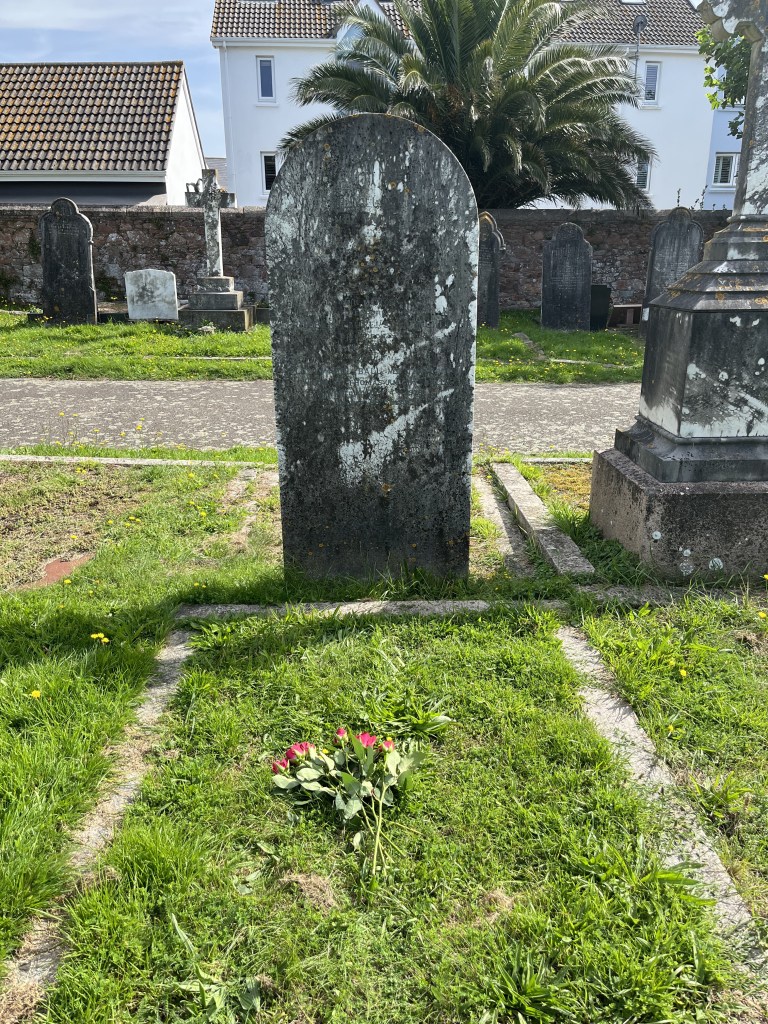
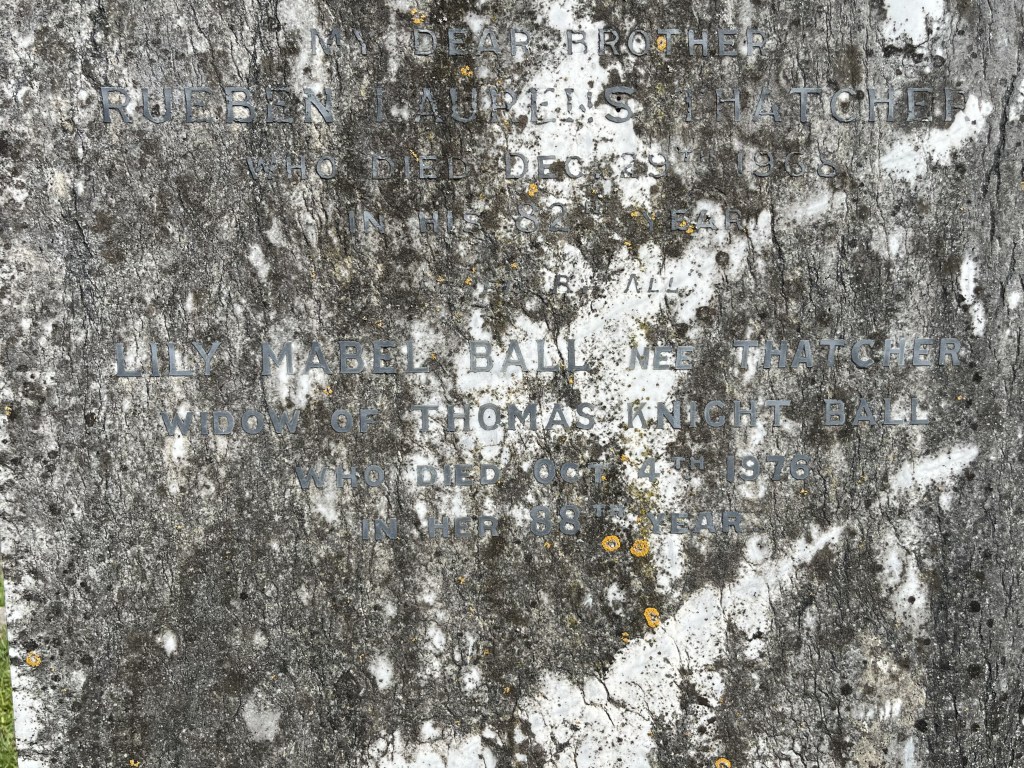
Lily begins by specifically stating that she wishes to be buried in “her grave” at the New St John’s Cemetery at  Mont-à-l’Abbé with her husband, Thomas Knight Ball (which she is).  They are both in Block V Plot 15 on the opposite side of the family put from her parents and elder brother. The gravestone also includes a memorial to Lily’s younger brother Reuben who was cremated and his ashes scatted on Plot 15.

The Thatcher Plot at Mont a’l’Abbé – Lily Mabel Thatcher, Thomas Knight Ball and a memorial to Reuben Lawrens Thatcher

Lily asks for her body to be repatriated to Jersey should she die elsewhere and she specifically instructs that she must be buried wearing her wedding ring.

Lily also leaves money in trust for her parents’ graves and hers and Thomas’s graves to be upkept in perpetuity.  

  • To Mr and Mrs John Tooke-Kirby of Goring on Sea the sum of £20,000
  • To her godchild David Tooke-Kirby £10,000 when he reaches 31
  • a Mrs Iris Laurens of “Iona” Greve d’Anette, St Clement, Jersey [a maternal relative on her mother’s side] £10,000 plus all Lily’s jewellery (specifically including “her five stone engagement ring and her solitaire diamond ring) and clothing with the exception of her gold bangle (see below)
  • Miss Gladys Marett of Overseas Flats, Dicq Road, St Saviour, Jersey £3,000
  • Mr and Mrs George Falle of 6, Beach Crescent, St Clement, Jersey [Lily’s mother Jane Laurens had a sister who married a man called Falle so presumably this was a maternal relative] £3,000
  • a Mr and Mrs Harborow of “Larmona” 65 Cleveland Gardens, Golders Green, London, NW2 £3,000 plus to Margaret Harborow, Lily’s gold bangle presented upon her retirement from Lloyds Bank, Lombard Street
  • Mr and Mrs Stanley P Le Ruez of “Freshwinds”, Bon Air Lane, St Saviour, Jersey £3,000
  • Miss Amy Le Cornu of “Hengistbury” Claremont Road, St  Saviour, Jersey £1,000
  • Mrs R Le Templier of 8, Cleveland Avenue, St Helier [the address where Lily died] £1,000
  • Mrs Gwen Talbot c/o Mrs Templier above £500
  • Dr and Mrs Norman Pitts of Red One Montauk Avenue, Stonington, Connecticut 06378, USA £2,000
  • Dr Barnardo’s Homes £4,000
  • the Jersey Blind Society c/o La Motte Chambers, St Helier, Jersey £5,000
  • St Dunstan’s (the organisation for men and women blinded in war service) £7,000
  • Brig-y-Don Children’s Convalescent and Holiday Home, Samares, St Clement, Jersey (to which her brother, Reuben had also left a bequest) £5,000
  • Cancer Research £7,000
  • Invalid Children’s Aid Association £7,000
  • The Home for Aged and Infirm Women known as “Glanville”, St Mark’s Road, Jersey “for providing amenities for the patient’s use” [probably means Lily was in there at some point] £7,000

Finally, Lily says any residue should go to the Jersey General Hospital in memory of her parents and her late brother, Reuben for the purpose of building a home, hostel or homes for old people in need to be called the “Knight Ball and Thatcher Home” or to extend the Jersey hospital with a ward or annexe to be known as the “Knight Ball and Thatcher Ward”. I have visited the hospital and no such ward exists.  Nor could I find a facility for elderly people of the same name. so what happened to that bequest is a bit of a mystery.

What a woman. Lily did such a lot of good with her bequests. I have visited the Thatcher family plot and shown you above a photo of the graves on the East side. Unfortunately, it is the Western side that gets very degraded by the weather and because of this, the gravestone is very, very hard to read. But I could make out some of the writing and it is clear enough that Lily and Thomas are buried there and there is specific mention of the stone also being a memorial for Lily’s brother, Reuben.

Close up of Lily, Thomas and Reuben’s memorial

So there they all are. The Thatchers. Lily was the last of them. Not my relatives but nonetheless incredibly interesting I think (I hope you do too).

I hope you’ve enjoyed reading this and thank you for visiting my site.

The Jersey Connection Part 1

You never know where family history will take you do you? I certainly never thought mine would take me to the Channel Island of Jersey and a tale of second marriages, an heiress and German War Records. But it has.

To put you in the picture. I got interested in one of my (it has to be said fairly distant) relatives when I found him heading to Australia to emigrate with his first wife when they were in their 60s. Seemed unusual. So I did a bit of digging. As you do …

Thomas Knight Ball (1858 – 1948) and I have a very distant connection. One of my paternal 4xGreat Grandfathers was Thomas Knight Ball’s 2x Great Grandfather. That makes him my 2nd cousin 3 times removed. I said it was distant … stick with me.

Thomas was born in Euston Square in the North West of central London to parents Thomas Oram Ball and Jane Knight in June 1858. His middle name follows the naming convention that the Victorians rather liked of giving children (particularly the eldest one which Thomas was) the mother’s family name as the child’s middle name (and very glad modern day family historians are for this given it often helps find and validate birth and other records).

Thomas’s father worked on the railways and the family always lived near a mainline station in central London (St Pancras, Cannon Street and in 1858, Euston) to the north of the river Thames. In Victorian times, railway building and expansion was key to make travel more accessible to everyone and the railway companies were major employers.

Thomas’s childhood appears to have been unremarkable and by the time of the 1881 census, when he was 23, Thomas is working as a Grocer’s Assistant in Old Bond Street, Westminster when he lived in a Boarding House for the grocer’s shop staff.

Thomas married Emma Auber at Falkland Road Wesleyan Methodist Chapel in St Pancras, London in 1882. They were both 24. Both living in Kentish Town. Thomas now gives his occupation as a Clerk.

Thomas and Emma continued to live in London until the 1901 census when they have moved to Brighton in East Sussex. But by 1911 at the time of the next census, they are back living in London. This time across the Thames in Brixton in the South West of the city. They have no children and are both 52.

13 years later, in September 1924, Thomas and Emma set off on the SS Ballarat bound for Melbourne, Australia. The passenger list says Australia is their “Future Permanent Address”. Just one year later however, they return to England stating that Kinninghall Road in Clapton, East London is to be their permanent residence. Thomas is described as a Farmer. Did they try their hand at farming in Australia I wonder and it didn’t work out? Did they get homesick? Or perhaps Emma was unwell and they wanted to come home. Sadly, Emma died from a heart condition a couple of years later. By this time though, they were back living in Sussex; this time in Worthing.

But it is after Emma died that Thomas’s life really gets interesting.

So having upped and gone to chance a new life in Australia at the age of 65 and returned less than a year after he sailed there with Emma, and following Emma’s death, Thomas seems to embark on a new life.  Much travelling, some with his brother, Francis, and then on to a new marriage to a woman much younger than him. Sigh. It was ever thus. But read on …

Less than three months after Emma has died, Thomas can be found coming back from Durban in South Africa on the same ship (the SS Edinburgh Castle) as his younger brother Francis. By this time, Thomas was 68 and Francis, 65. They embarked at Natal and disembarked at Southampton. Both give addresses in Worthing as their proposed permanent residence. They travelled in 3rd Class. 

Then, four months later, Thomas and Francis are shown on a passenger manifest coming back from Montréal, Quebec in Canada.  They embarked in Quebec and disembarked in Liverpool on the SS Doric.  They travelled in what is described as a “Tourist Cabin”.  Thomas is 69 by now.

Then at the end of 1927, Thomas remarries. He is 69 and described as a Widower. Lily Mabel Thatcher, Thomas’s new wife, is 38 and a Spinster.  She comes from Jersey in the Channel Islands.

Now, I can hear the wheels turning in your head. Young woman. Older man (31 years older to be clear …). A gold digger for sure. Well, think again, dear reader. Lily is single, comes from Jersey, a place known for its substantial economic wealth and high net worth individuals even in the 1920s and 1930s. Thomas has come from very ordinary stock and is travelling the World in Steerage. Who is digging gold you may wonder.

Lily Mabel Thatcher (1889-1977)

Lily is intriguing. A bit of an enigma. I wish I’d known her.

Lily Mabel Thatcher was born on 23 April 1889 in St Helier in the channel Island of Jersey to parents John Charles Thatcher and Jane Ann Lawrens. John was a self made, very successful businessman and owned the island’s biggest painting and decorating company. Jane was from a very old, established Jersey family.

Lily was the youngest of of John and Jane’s four children. Lily had two older brothers, Charles and Reuben and a sister, Ida. Ida died aged 14 in 1899, from Meningitis.

Lily Mabel Thatcher, about 1940

Lily lived at home with her parents and family until at least the 1921 Census taken in June of that year

Lily’s father died in January 1922 and left his entire estate (I suspect a substantial one) to his wife, Jane Lawrens.

In August 1922, aged 33 and unmarried, Lily leaves Jersey and sails from Southampton to Montrèal on the SS Andania. She is travelling with a Mrs Violet Chapman, aged 34 and described as a housewife of St Helier, Jersey and her 4 year old daughter, Pearl.  Lily gives the same address as Mrs Chapman and Pearl in Jersey. The Arrivals Form in Canada says that Lily is single, has £5 on her, is in Canada with Mrs Chapman on holiday and they are both destined for 592, Union Avenue, Montrèal.

On 5 January 1923, Lily comes back from Canada on the SS Minnedosa which departed St John’s, New Brunswick, Canada for Southampton on that date. Lily gives her mother’s address as the one to which she is going to live in St Helier.

I cannot find Mrs Chapman or her daughter on the passenger list but she is to be found coming and going frequently and regularly between the UK and Canada variously to Montreal or St John’s in the years after Lily left and on one passenger list Violet Chapman gives her last country of domicile as Canada. Intriguing but not relevant to our story.

In 1924, Lily’s mother died. Jane Lawrens leaves the house in which she is living jointly to Lily and her younger brother Reuben. Various other items of furniture are left also to Reuben. Jane’s eldest son Charles is the Executor of Jane’s Will and received a tea service (a Japanese tea service to be precise). The remainder of Jane’s estate (the bulk of which was presumably what she was left by her husband two years previously) Jane leaves to Lily.

This is the first in a series of bequests Lily receives from her family.

Then sometime during these years, Lily somehow meets Thomas (I would lay money on it that they met on a ship but I have absolutely no evidence to corroborate this). They marry in 1927 in Worthing where Thomas had lived with his first wife. Both in fact giver their address as the house in which Thomas lived with Emma and where Emma died. The marriage takes place in a Baptist Chapel and the witnesses were Thomas’s brother, Francis and Lily’s younger brother, Reuben. 

During the 1930s there are various records of Thomas and Lily travelling by ship to some fairly exotic destinations. In 1934, they are sailing from Liverpool on the SS Ulysses bound for what seems to be a cruise that goes via Marseilles, Port Said, Colombo, Penang, Singapore, Java, “Australian Ports” and returns to the UK via South Africa before docking finally in London. Both give their address as Jersey in the Channel Islands.  Thomas is 75 and Lily 45. There is a record of them coming back from Indonesia on the Ulysses in January 1935, presumably the same trip.

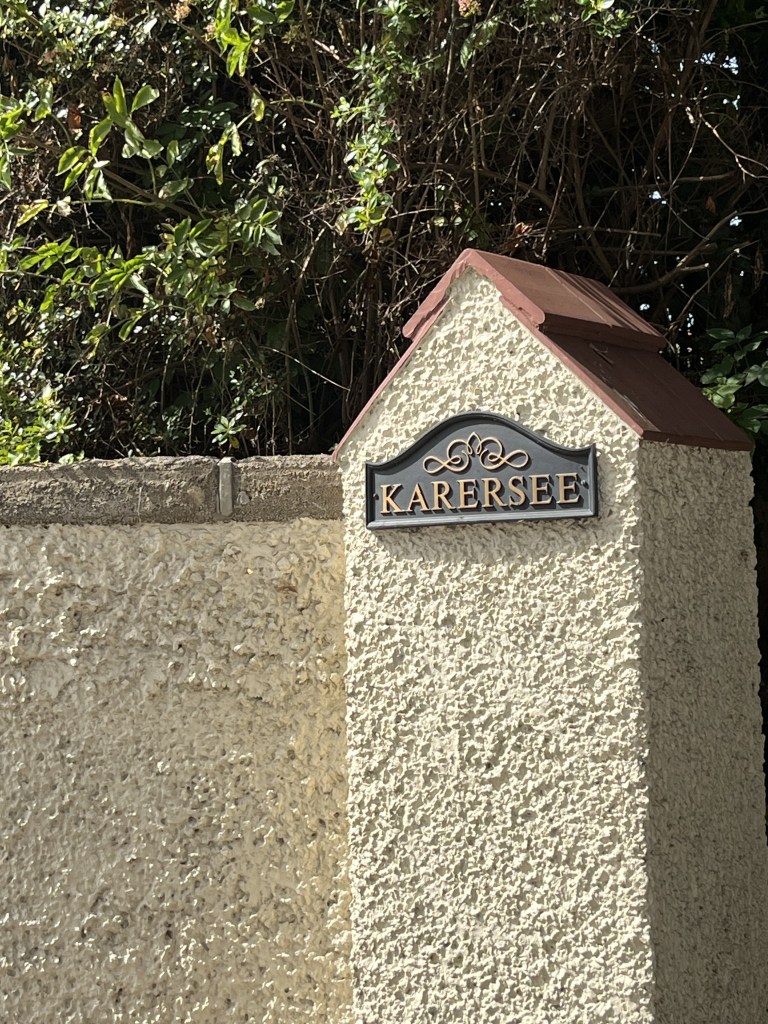
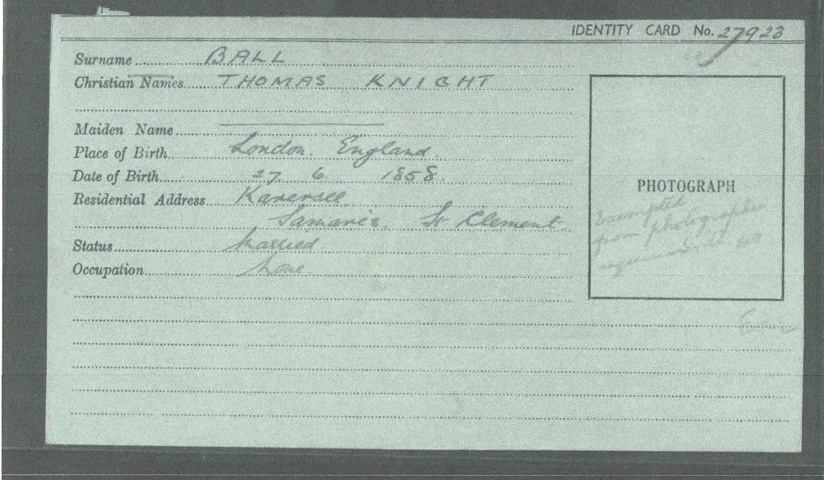
On the passenger manifest, Thomas and Lily give their address in Jersey as a house called “Karersee” in Samares, one of the twelve Parishes of Jersey, located on the South East coast.

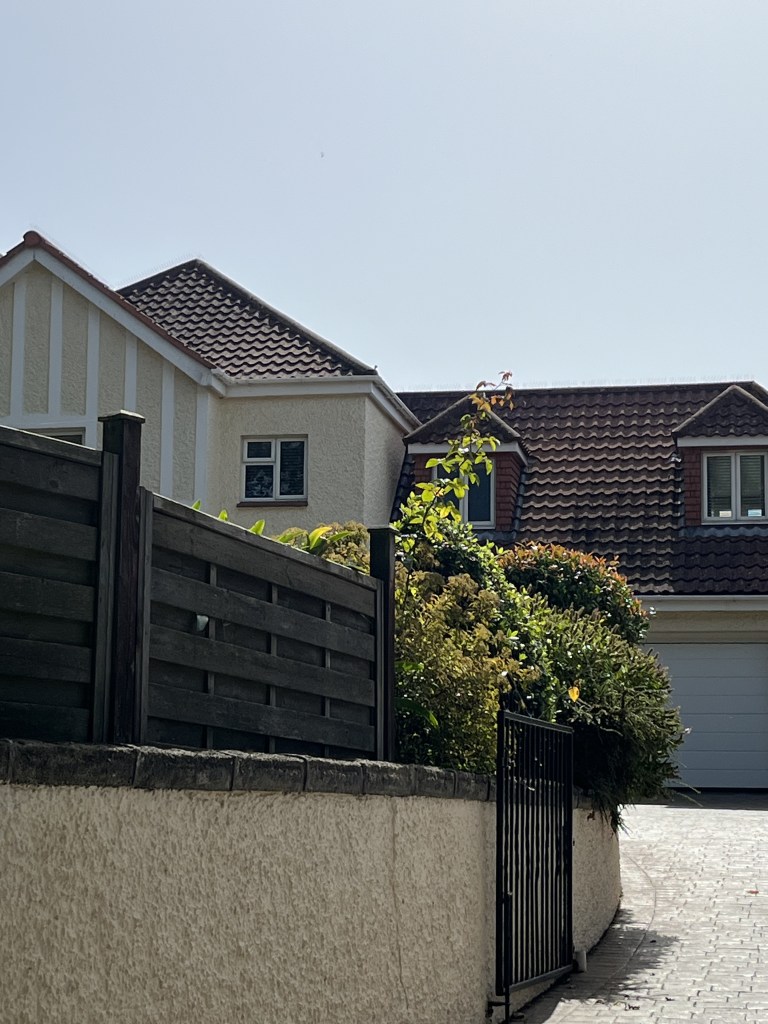
I have been to look at the house. It is a fairly unremarkable but substantial house near to the main coastal road. I imagine the house has been updated since the 1930s but it is still interesting to see it I think

“Karersee”, Samares, Jersey, CI Home of Thomas and Lily

The only reference I can find to the name Karersee is Lago di Carezza in the Italian South Tyrol in a place called Trentino which an autonomous province in the north east of Italy. In German it is known as Lake Karersee. In English, the Rainbow Lake. It looks beautiful. I’d like to think someone name this lovely house on Jersey after that lake. I’d also like to think it was Lily and Thomas ❤️ …

The Channel Islands are a self-governing parliamentary democracy under the constitutional Monarchy of the Crown of Great Britain. The Channel Islands are not part of the United Kingdom but are known as one of the “British Islands”. They have their own financial, legal and judicial systems and the right to self determination. As such the islands are reigned over by the British Monarch, currently King Charles III. There is a Lieutenant Governor resident on Jersey who acts as a link to the Monarch but the Channel Islands are entirely self governing.

On 1 July 1940 the islands were the first and only part of Great Britain to be invaded and occupied by the German forces during the Second World War. The occupation lasted almost 5 years until 9 May 1945 when the Germans surrendered and the islands were liberated.

This occupation has led to the Channel Islands having very different records during this time from other parts of Great Britain and the United Kingdom. Primary of these (and of most use to family historians) is the identity cards all citizens were required to have by the occupying Forces.

The Jersey Archives have digitised these records and a lot of others created because of the very difficult circumstances in which the island found itself in 1940-45.

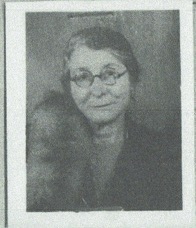
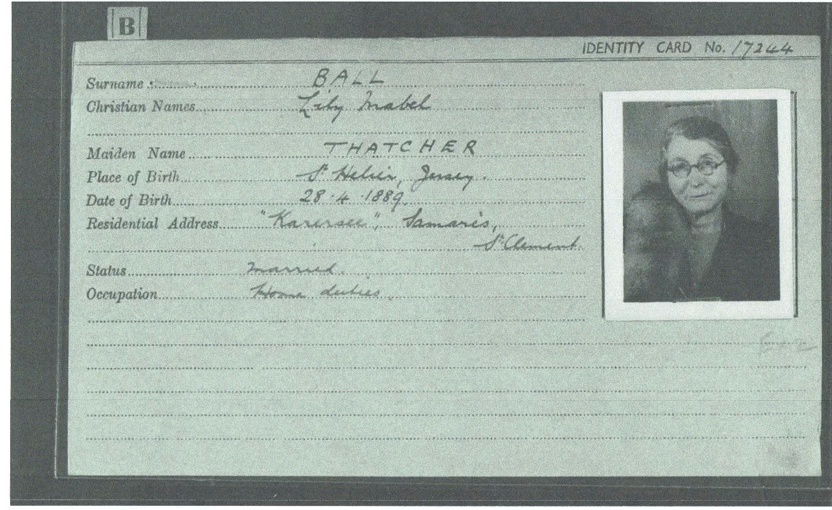
Each identity card had personal details of the Channel Islands’ citizen plus (in most cases) an up to date photo. This is Lily’s (I do love the way she has included the addition of her fur stole just thrown over her shoulder and don’t you think her eyes just look super defiant behind those glasses?).

This is the form that was completed for Lily in order to have her card issued. She had “brown hair with some white” she says and brown eyes. The eagle eyed amongst you will notice that her date of birth is slightly different from the one I’ve used from her birth and baptism record but these were difficult times and which of us could say we could remember our birthday when faced with an invading army?

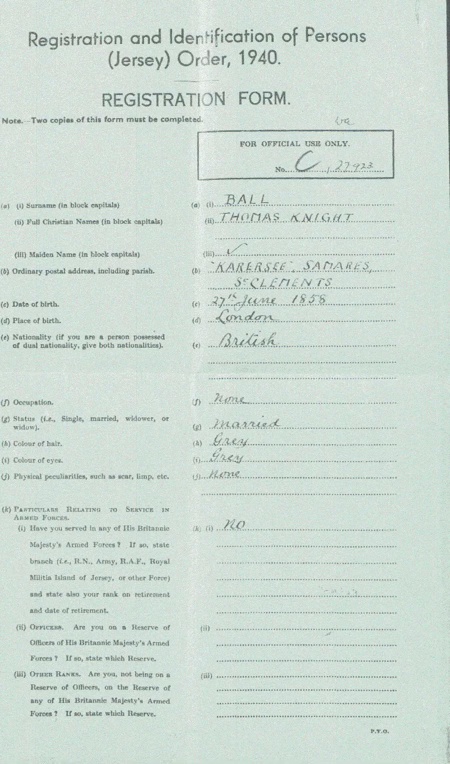
Thomas’s registration card has no photograph (it says he is exempt from giving a photo but I can’t read why). I’ve included below his registration form and card.

Thomas says he has grey hair and grey eyes. At the time of the occupation of the Channel Islands, Thomas was 82 and Lily was 51. Not the final years of their relationship they would have chosen I imagine.

Three years after WW2 ended, Thomas died on 16 February 1948 aged 89.

Thomas had made his Will 16 years earlier, in 1932. Thomas leaves everything to his wife, Lily with the caveat that, should she predecease him, everything is to go to her brother, Reuben. Thomas makes it clear in his Will that has “abandoned” his domicile of origin and intends to live the rest of his life in Jersey.

Whilst I don’t doubt that Thomas’s estate was inferior to Lily’s there was presumably some residual benefit that Lily received.

Birth, marriage and death events are recorded differently in Jersey from the remainder of Great Britain. I have validated Thomas’s death from his funeral and burial records. In Jersey, records of burials and cremations are far more detailed and extensive and as such contain a lot of useful information. so while I don’t know what Thomas died from, I do know that his funeral was carried out at St Luke’s Church by the Reverend Pawson (who charged £10 for his services) and that the funeral cost 40 pounds 3 shillings and 6 pence (younger readers please look this ancient form of currency up here https://www.royalmintmuseum.org.uk/learning/learning-zone/going-decimal/old-money/) and the Funeral Director’s bill was settled in March 1948 by Lily. Exactly where the Church is is obscured by an annoying ink blob on the original record , but to this day there is a St Luke’s Church in St Saviour’s Parish which borders St Clement’s Parish and is just to its north so I’m going for that one.

The Jersey Archives’ Burial Records give me Thomas’s exact date of death and his place of burial. Thomas died on 16 February 1948 aged 89 and was buried in Mont à l’Abbé Cemetery in St Helier two days later.

Mont à l’Abbé Cemetery is a vast cemetery in the capital of Jersey (and indeed the capital of all the Channel Islands). Thomas and Lily are buried together there (spoiler alert – Lily does die but not for a while …) in the Thatcher family plot. But that’s all for Part 2.

Thank you for reading. I promise to be back very soon with the next instalment …

The Church of the Most Holy Trinity, Dockhead, Bermondsey

The Church of the Most Holy Trinity, Dockhead

The Church of the Most Holy Trinity is the Roman Catholic Parish Church of Dockhead.

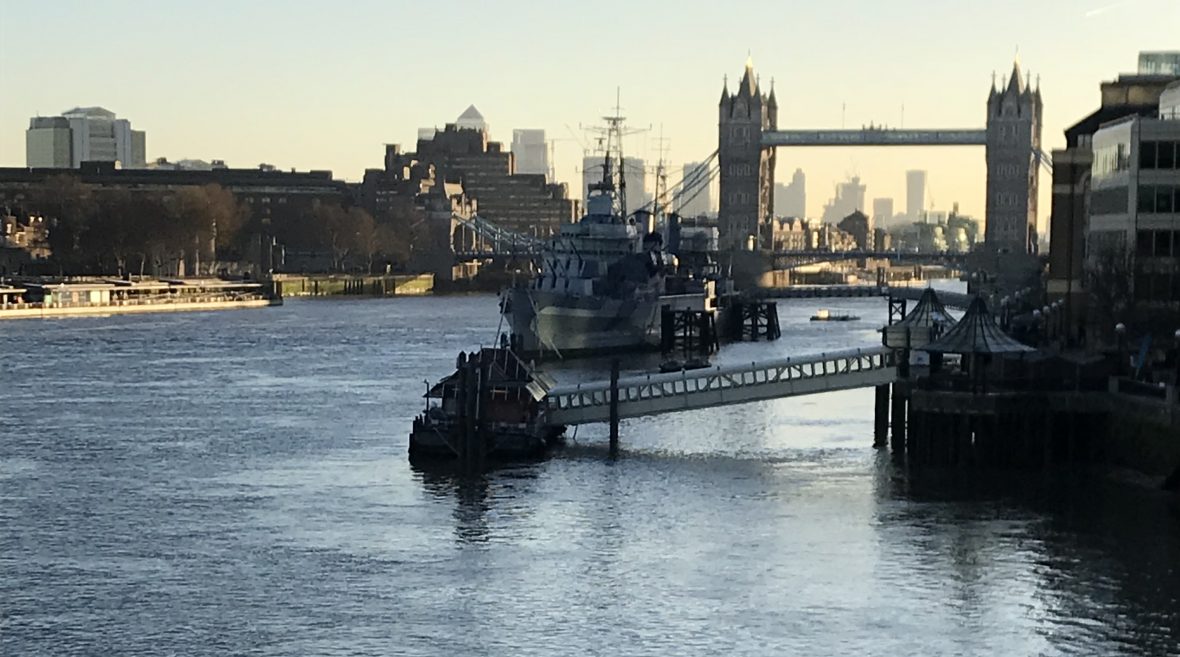
Dockhead is an area situated just north of Jamaica Road in Bermondsey and runs east/west just south of Tower Bridge. Named to describe its geographical position at the “Head” of the London docks on the South side of the Thames, Dockhead was home to the Dockers, Stevedores and Lightermen who worked in the Docks up until their demise in the 1970s and 1980s and in terms of my family history, home to most of my Mother’s family during the nineteenth century and up until the Docks’ decline. I lived just off Jamaica Road not far from Tower Bridge when I was a child in the 1950s and my Dad and several of his brothers all worked in the London Docks.

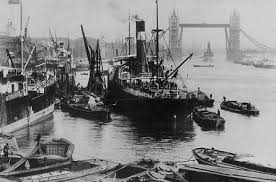
The Docks were known as the ‘larder of London’. Everything came through these Docks, frozen meat, spices, tobacco, wool. All unloaded and distributed from the huge ships that came up the Thames up to Tower Bridge or stored in the vast network of Warehouses on both sides of the Thames. Three-quarters of the butter, cheese and canned meat needed for the capital was stored here.

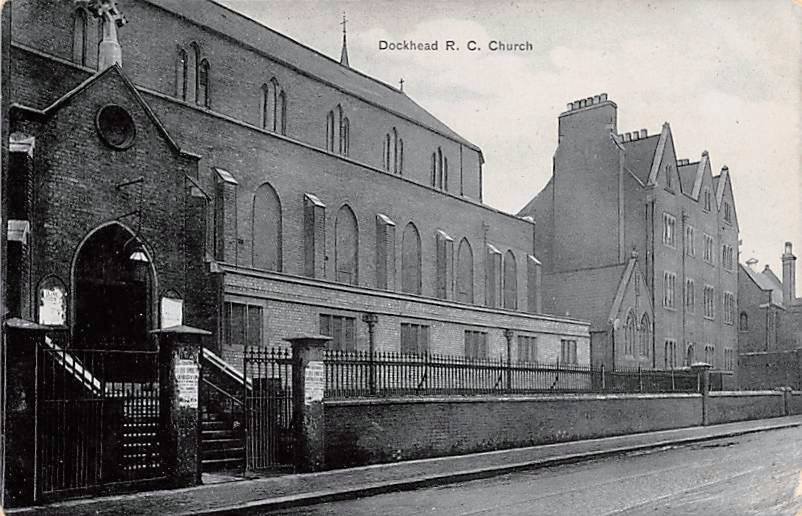
There has been a Roman Catholic Church on the site of the Most Holy Trinity Church since at least 1773 and it was the first church to be built fronting a public highway since the Reformation.

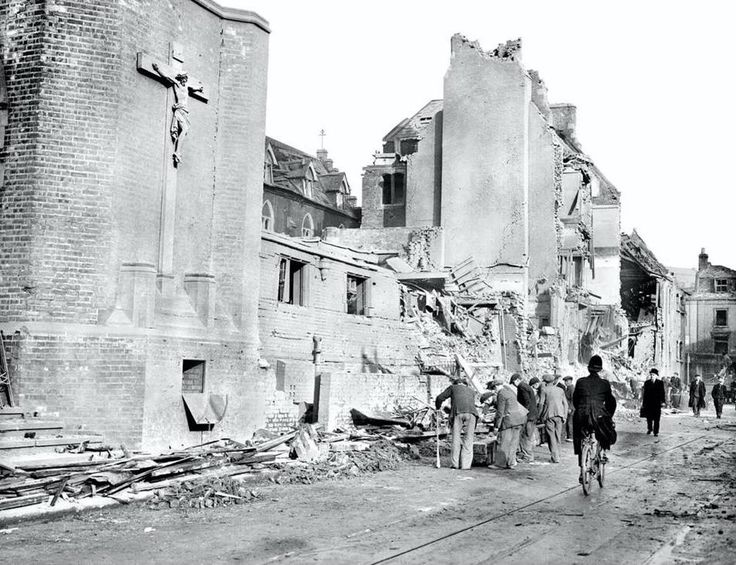
Dockhead suffered terribly during the Blitz in WW2 due to its proximity to the Docks. Between 7 October 1940 and 6 June 1941, 126 high explosive bombs and 2 Parachute Mines were dropped on the area (https://www.bombsight.org) and in December 1940, the Church was destroyed in a bombing raid. Sadly, five years later, just before the end of the War on 2 March 1945, the Priests’ House was also bombed and three of the four Parish Priests were killed. The fourth was badly injured and rescued only with great difficulty. His rescuer, a milkman, received the George Cross. The adjoining Convent of the Sisters of Mercy was also damaged but with no loss of life. I can’t help thinking that my family must have known the Priests and were almost certainly members of the congregation.

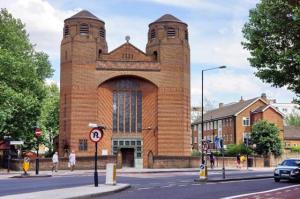
But the Church was eventually rebuilt and the present polychromatic brick building (first illustration above) was designed by H.S. Goodhart-Rendel and completed in 1959. The modern building was designated Grade II Listed but was upgraded to Grade II* in 2015.

The Church features heavily on my Maternal family tree. So far, I have found 12 marriages and 3 Baptisms at the Church from 1852 to 1931.

The furthest back of these is the first marriage of my 2 x great Grandmother, Hannah Lyons, who married a Michael Taylor there in 1852.

Hannah was born in Ireland in the early 1830s (not sure exactly when) and was living in England by the time of her marriage to a Michael Taylor in 1852.

It may have been that Hannah’s family came to England a s a result of what became known as “The Irish Potato Famine” between 1845 and 1852 when almost 2.2m people mostly from southern and western Ireland emigrated to England or America following the failure of the potato crop on which they depended, predominantly due the infection of potato crops by a blight that affected crops in other countries in Europe as well. Over 1m people starved to death in Ireland alone.

Hannah and Michael continued to live in Bermondsey and had three children. Johanna who was the mother of the Kalaher orphans who were the subject of an earlier blog post on here (see link below), John and Julia who was my great grandmother.

Michael Taylor died in 1874 from Bronchitis (not unusual then in this damp area around the London Docks) aged 46.

Hannah remarried a couple of years later to a Thomas Sullivan but by 1891 Hannah is again a widow. Hannah’s two younger children, John and Julia, are still with her but by then Hannah’s other daughter, Johanna and her husband had both died leaving their children orphaned and Hannah has taken three of them to live with her.

On the 1901 census, Hannah is living with her youngest daughter Julia and Julia’s husband and she died just a few months later aged 65.

Both Hannah and Michael’s daughters, Johanna and Julia married at Holy Trinity (Julia giving birth to her first child just five days later) as did Julia’s daughter, also called Hannah (my grandmother) two of her other daughters and her son who were all my great Aunts and Uncles.

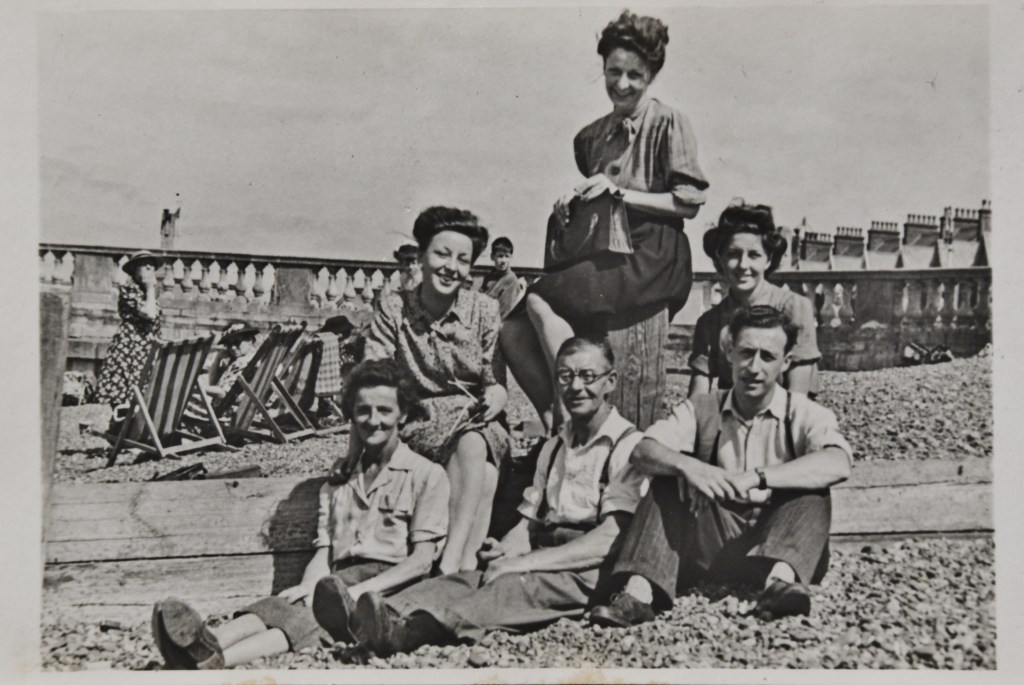
I can’t find any photos of my Grandmother and grandfather’s wedding (perhaps there weren’t any …) but here’s the little family they made including my lovely Mum, Marie and her sisters Hannah (this Hannah was baptised at Holy Trinity too) and Eileen plus Hannah’s husband enjoying a day at the beach I’m guessing in the late 1940s, perhaps early 1950s.

Thank you for reading this and I’m sorry I’ve been away so long ❤️

The Marriotts Part III

So, by late September 1918 (just a few weeks before WW1 ended on 11 November) four of the ten children born to Elizabeth Louisa Whale and Sidney Randolph Robert Allies Marriott had been killed fighting in various countries around the World. One was 27, two were 23 and one 22. What a devastating loss and one that must have been difficult for all the family to bear but particularly Elizabeth and Sidney.

Elizabeth was already the only surviving child of William Whale and Elizabeth Rose. Elizabeth had had four sisters and a brother but all of them died either in infancy or as young adults. Elizabeth’s father had died aged just 40 leaving her and her Mother alone.

After her marriage to Sidney, children follow year on year almost and as I said in Part I, the Marriotts seem to live a fairly grand life in nice houses in what are now London Boroughs but in what would then have been leafy suburbia.

After WWI had finished, Elizabeth continued to live in Streatham, South West London until the time of Sidney’s death in 1924 when Sidney’s Last Will and Testament details that all his estate would be left to his wife Elizabeth.

When Elizabeth died, two years later in 1926 aged 73, she is living with her son Claude and his family in their house in Horsell in Surrey. A very grandly named “Cintra”.

But it is Sidney’s life after WWI which gives us more of an insight into the effect of the loss of their sons I think.

Sidney had obviously been a very capable and educated man. He had held a high ranking post in the Civil Service. He had a large and well provided for family.

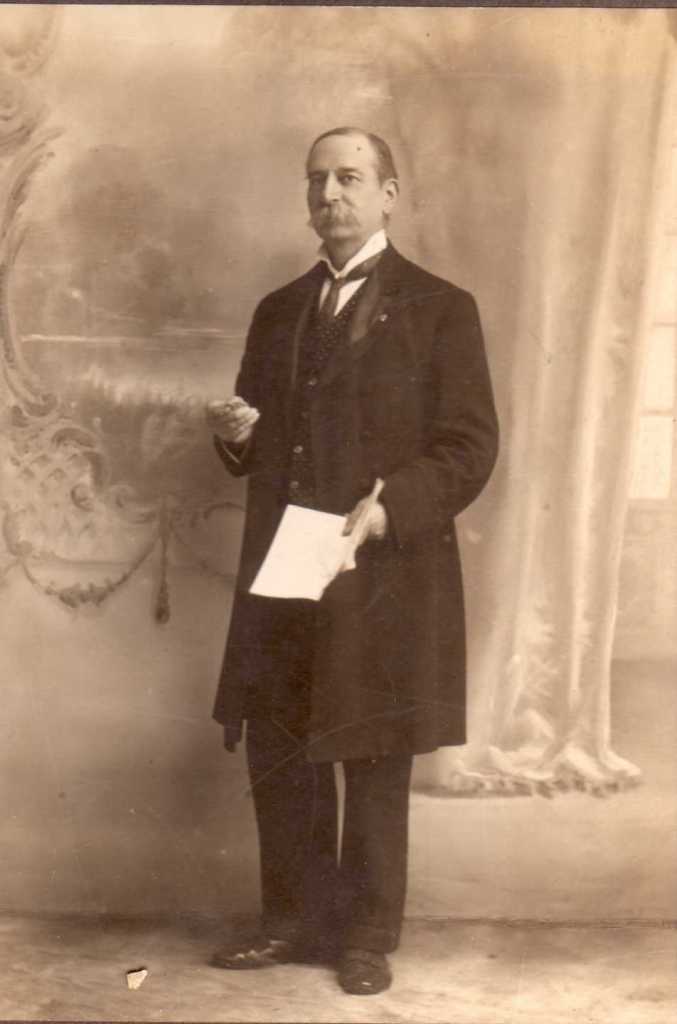
Sidney Randolph Robert Allies Marriott

After he retired from Whitehall, it seems he held a reservist post as Quartermaster of the London Volunteer Regiment during WW1. The Quartermaster generally runs the Stores and Barracks for a Regiment and holds the rank of Captain or Major. Sidney is noted as such on his youngest child, Kenneth’s, Last Will and Testament in which Kenneth leaves his Estate to Sidney when Probate is granted in 1919.

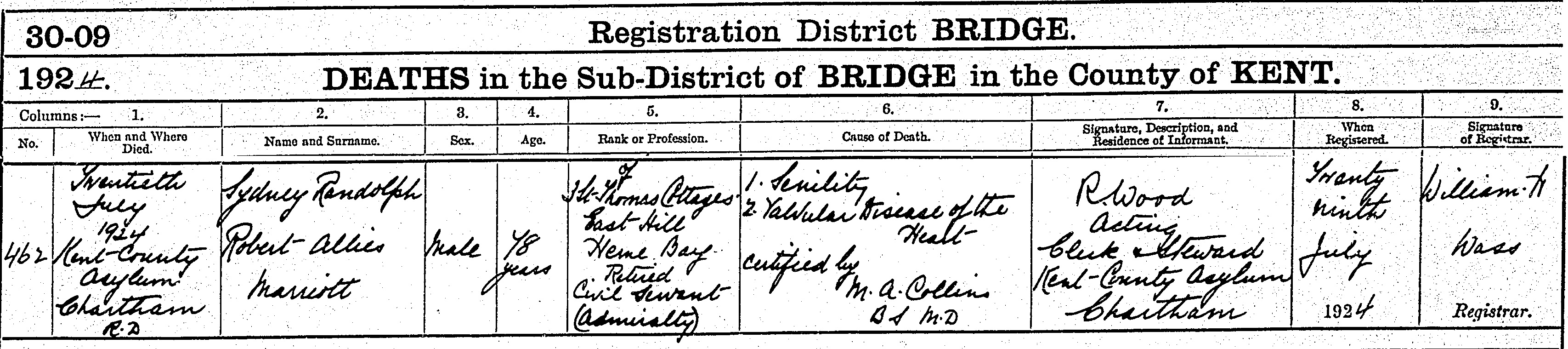
Sidney died in 1924 aged 78. But when he died, his address is given as one in Herne Bay on the Kent coast and the place of his death is the Kent County Asylum in Chartham, Kent.

Sidney Robert Randolph Allies’ Death Certificate

Regrettably, none of the records for this institution survive so it is difficult to know what Sidney’s diagnosis might have been or when exactly he was admitted. But certainly I can guess. I suspect (and so will you I should think) that the loss of his four boys one after the other in the brutal fighting of the War was just too much to bear and Sidney needed to be cared for in a specialist facility where he finally died away from his family and most sadly, his wife of 46 years. How very sad and what a lesson about the toll that War takes on families. Not just the obvious needless loss of life but the enduring effects of loss and sadness.

Just before I go. A quick word about Sidney’s Father, Thomas Weatherley Marriott (1791 – 1857). Thomas was a Barrister. In 1823, a year before Thomas Cubitt struck his deal with Lord Grosvenor and began his famous work in Belgravia to set out and build Eaton Square, a tract of land that formed part of the Moreau family property further to the West was sold for development to a John Betts and Thomas Weatherley Marriott.

Betts and Marriott proceeded to design and develop a simple grid of streets and a square with a connection to Brompton Road. Hampered by a lack of access to Kensington Road, Thomas Marriott struck a deal a few years later with Lord Dungannon to buy land to the east which provided access to the neighbouring Trevor Place and upwards to the north. And thus, Montpelier Square was formed. Properties there today sell for £8m plus. A direct relative of the Marriotts (from Shirley Marriott’s line in Australia who has provided the photographs I’ve used on these blog posts) with whom I’ve been corresponding on Ancestry.com tells me that any money that Thomas had in order to buy this prime real estate in Knightsbridge dried up after the development. No fortunes to be handed down through the Marriott line it seems.

So that’s me done with the Marriotts. What a family. Such stories and sadness. Lives lived and lives lost. Of a whole family changed by WW1. I think the distraction in this case was well worth it.

As always, thank you for reading this post.

The Marriotts Part II

So I was telling you that there was trouble ahead for the Marriotts when they were all pictured together in 1908 at Claude’s wedding.

But not for them all. Six of the ten Marriott children survived WW1.

Arthur Weatherley Trevenan Marriott did not marry and did not serve in WW1. Like two of his brothers, he followed his Father Into the Civil Service and became, like his Father, an Admiralty Clerk.

Arthur and his sister Madeleine were made co-Executors of their Uncle’s Will in 1924 and Arthur seems to have lived his life after receiving this inheritance in a hotel in West Kensington in London.

Arthur died from heart failure in Charing Cross Hospital in Hammersmith in 1943 aged 64 . You will recall from Part I that he is buried in Nunhead Cemetery along with his sister, Madeleine. Arthur was the seventh and last burial in the family plot.

Madeleine Delano Marriott also did not marry and after receiving her half of her Uncle’s estate, she bought a guest house in Hammersmith in West London.

Madeleine died in Hammersmith Hospital aged in 1941 aged 61 from “Acute Bacterial Food Poisoning due to consumption of contaminated food at her home”. Post Mortem Verdict – Misadventure. Goodness.

Madeleine was the sixth burial in the family plot in Nunhead Cemetery.

Claude Randolph Marriott also became an Admiralty Clerk (like his Father and brother, Arthur) and latterly an Engineer. He married a Naval Architect’s daughter and lived rather grandly it seems in large houses in Surrey. Claude died in 1959 aged 77.

Ethel Clara Marriott married twice. Her first marriage produced a daughter who went on to be Headmistress of the International School in New Delhi, India from 1954 – 1980. Ethel was widowed in the early 1950s, remarried in 1953 and she and her husband travelled frequently to see her daughter in India.

Widowed again in 1969, Ethel lived out her life with her daughter who had come back to the UK after her retirement. Ethel died aged 99 in 1982.

Kathleen Mabel Marriott married and had two sons. She died aged 80 in South Africa. I have no idea how this came to be but there it is.

Weatherley Sidney Mortimer Marriott served in WW1 in the 25th London (Cyclists) Regiment. Weatherley married twice. His second wife died in 1950 and left him a substantial amount of money. Afterwards he is to be found travelling extensively around India and the Far East. Weatherley died in 1969 aged 81.

But the four youngest children of the Marriott family, all boys, all died in WW1.

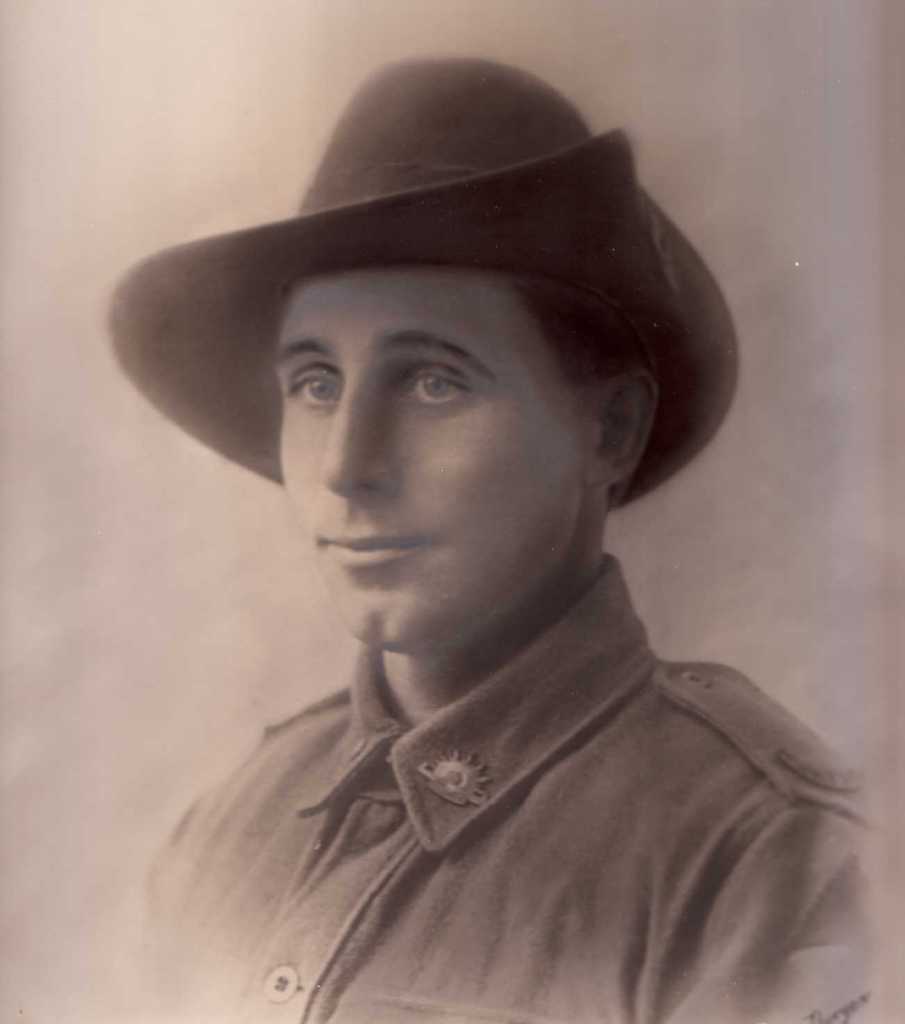
Shirley Verdon William Marriott (no clue about why he was named Shirley …) married a Hilda Maybury on 5 November 1913 in Wandsworth Register Office. The very next day the two of them got on the steamer, SS Ballarat and sailed for a new life in Adelaide, Australia where Shirley became a Woollen Warehouseman’s Assistant. Shirley and Hilda had two sons born in 1914 and 1916.

In that same year, Shirley enlisted in the Australian Army and embarked overseas in April.

Shirley Verdon Marriott in his Australian Army Uniform

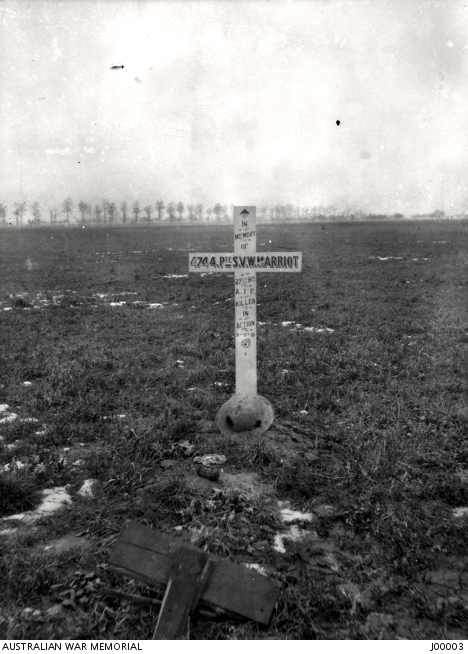
Shirley was sent to France and died in the Somme Valley in Northern France on 9 August 1918 aged 27. He is buried in the Heath Commonwealth War Graves Military Cemetery, Harbonnieres, Department de la Somme in the Picardie Region of France. But before he was buried in this cemetery, his colleagues (presumably) buried him in the Somme Valley in the mud and filth that the soldiers had to endure. This is Shirley’s original grave in the Somme. Such a tragically sad photograph. His hat seems particularly poignant.

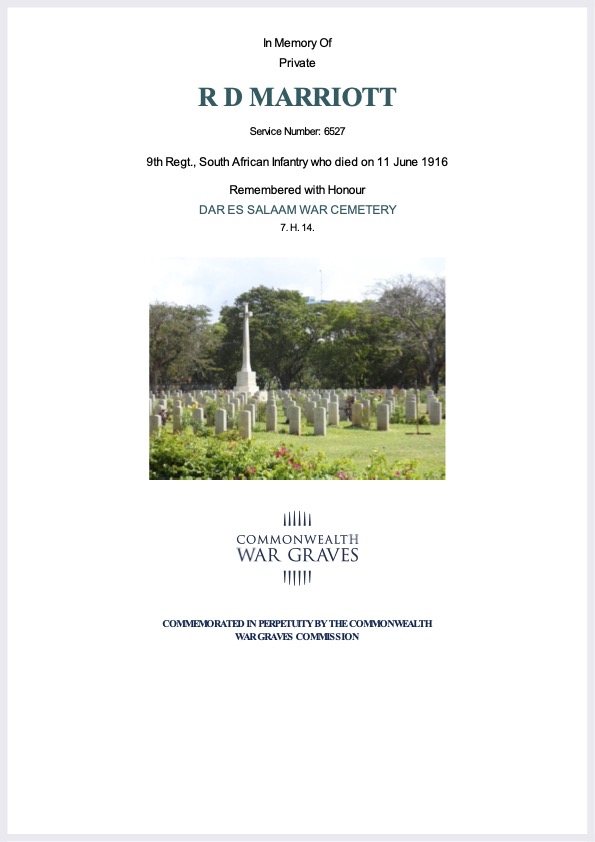
Roy Dudley Marriott boarded a ship to Cape Town, South Africa when he was 19 in 1913 to start a new life as a Farmer.

In 1916, he joined the South African Army and was sent with Allied troops to attack the Germans in the heart of their territory known as German East Africa. Roy died in June 1916, aged just 23, in Tanzania (formerly Tanganyika) and is buried in the Commonwealth War Grave Cemetery in its capital, Dar es Salaam.

Commonwealth War Graves Cemetery, Dar es Salaam, Tanzania

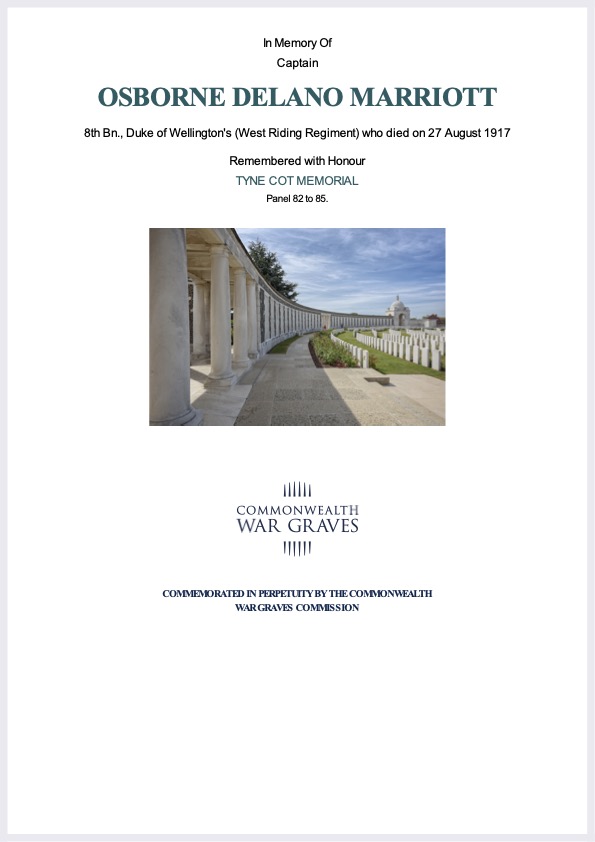
Osborne Delano Marriott served as a Cyclist in the 25th London Regiment (as had his brother, Weatherley), then as a 2nd Lieutenant in the Prince of Wales Own (West Yorkshire) Regiment before being promoted to Captain in the Duke of Wellington’s (West Riding) Regiment.

Osborne was sent to France in 1915 and died in August 1917 also aged 23. He is remembered on the Tyne Cot Memorial in West-Vlaanderen in Belgium, a monument to the missing of WW1 who have no known grave. Most of these casualties died in or around the fighting in Ypres, Belgium.

The Tyne Cot Memorial, West-Vlaanderen, Flanders, Belgium

Kenneth Melbourne Hugh Marriott was the youngest of the Marriott children.

Kenneth served in WW1 in 25th London (Cyclists) Regiment (as had his brothers Weatherley and Osborne) then the 1st West Riding Regiment and then the Royal Flying Corps and Royal Air Force where he attained the Rank of 2nd Lieutenant.

Kenneth died, aged just 22, in Palestine (now Israel) which was then part of the Turkish Empire. Kenneth is buried in the Commonwealth War Graves Military Cemetery in Jerusalem.

Commonwealth War Graves Cemetery, Jerusalem, modern day Israel

Gosh, didn’t the Marriott boys get flung far and wide? The World War really was the World War for them wasn’t it? From Australia to France, South Africa to Tanzania, London to Belgium and Palestine. And in all the four. locations that are their final resting places, the Commonwealth War Graves Commission keeps the graves looking pristine, ordered and dignified. Never Forget.

But what about their parents? What happened to them? And how did they cope with this devastating sorrow and loss of their four. youngest sons?

Part III coming soon.

Christmas Weddings

During the 18th and 19th Centuries, it was not unusual for weddings to take place on Christmas Day.

In fact, churches held special events to enable weddings to take place and young couples flocked to get married at Christmas. However, this was not for some desire to capture Christmas romance. The real reason was entirely practical.

With so many people working “in service” (as servants) usually Christmas Day and Boxing Day were the only days off they were likely to get off in the whole year (most people worked six days a week and did not get paid for the one day they didn’t work) and if they wanted to get married, the opportunity to do so on Christmas or Boxing Day would have been very welcome .

Christmas Day is a traditional holiday and is not, and never has been a bank holiday in England, Wales or Ireland. Sir John Lubbock first introduced bank holidays. He was a banker and politician who loved his cricket and couldn’t stand the idea of competitors gaining an advantage by trading on days he and his staff went to support or play in their local village matches. He introduced the Bank Holidays Act 1871 which recognised four official bank holidays – Easter Monday, Whit Monday, the first Monday in August and Boxing Day. The same act did make Christmas Day a bank holiday in Scotland.

On my Mother’s side of my family, I have so far found eight Christmas Day weddings including my own maternal Grandmother, Hannah Cownley, who married Frederick Mason on 25 December 1919.

At the time of their wedding, Hannah and Fred were both living in Bermondsey. Hannah was working as a “Factory Hand at a Jam Factory” and Fred was a “Farrier Journeyman” (so someone who looked after horses’ hooves – can’t imagine needing one of those in Bermondsey now can you?)

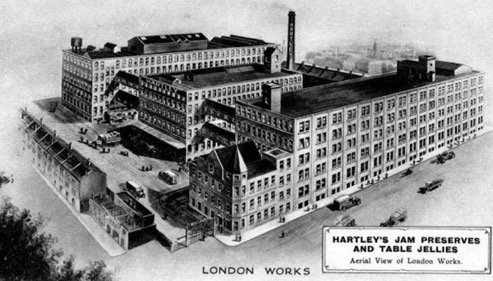
Hannah was likely to have worked at Hartley’s Jam Factory which employed about 1,500 people in Bermondsey at the beginning of the 20th Century.

Hartley’s Jam Factory Bermondsey, 1920s

Neither Hannah nor Fred will have had much time off and I imagine a Christmas Day wedding would have been appealing to them (the other added incentive would doubtless have been that Hannah was about 7 months pregnant with their eldest daughter, also called Hannah and born on 4 March 1920).

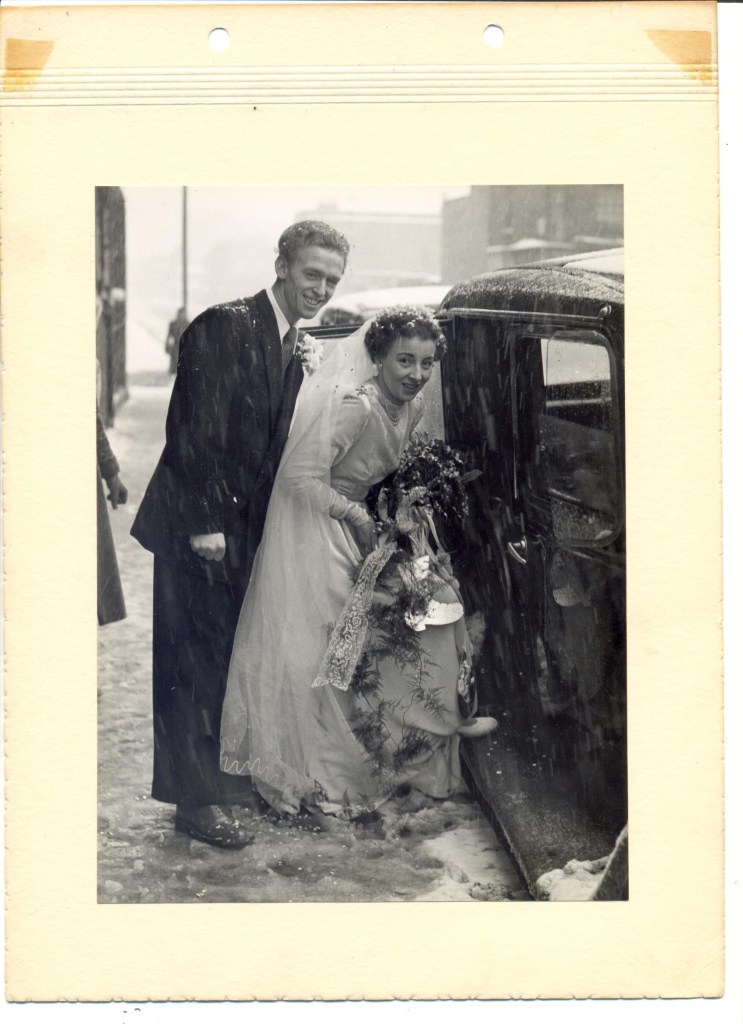
I don’t have any family wedding photos older than the 1950s. But here’s one of my Mum (Hannah and Fred’s youngest daughter) and Dad who got married in late March 1952. In the snow funnily enough …

Marie Mason and Stanley Charles Ball, The Church of Our lady of Seven Dolours, Peckham, South London 29 March 1952

In case you were wondering, there’s no legal reason why you can’t get married on Christmas Day nowadays. But no one really wants to because they don’t have to I suppose and most Churches are likely to tell you they are too busy (Register offices are not open so no Registrars available for other venues).

Anyway, Happy Christmas to anyone reading this. I shall be back with more stories in 2021.