Blog

The Kalaher Orphans

The Kalaher orphans, all six of them, are my 1st cousins twice removed.   They have fascinating stories and I have worked out that my maternal Grandmother, Hannah, who was their cousin, must have known at least some of them. I find that extraordinary. As the actress Olivia Coleman said in her episode of Who Do You think You Are, “we have touched hands through time”.

My Great great Aunt, Johanna Taylor (1856 – 1887) who was my Great grandmother’s sister, married a Bartholemew Kalaher at the Roman Catholic Church of the Most Holy Trinity in Dockhead (named since this area was literally the Head of the then vibrant London Docks) in Bermondsey in June 1873. Bartholemew was a Labourer and he and Johanna were living just a few doors away from each other near the Thames in Bermondsey when they were married.

The Church of the Most Holy Trinity, Dockhead, Bermondsey

Like most poor people in Bermondsey at that time, Bartholemew and Johanna moved around a lot but never far from where they had grown up and where they were living when they got married.

Johanna and Bartholemew had seven children,

Mary Ann born 1874,

John born 1875

Thomas born 1877 (died in 1886 aged just 9 from Heart Disease)

Ellen born 1879

Catherine born 1883

James born 1885 and

Albert born 1886

In December of 1887, when her youngest child was just over a year old, Johnna developed Bronchitis and died aged just 31. Her husband, Bartholemew registered her death and was left with six children to look after. But there was more tragedy to follow when in the following May, aged just 34, Bartholemew himself died from Broncho-Pneumonia. Bartholemew’s death was registered by Johanna’s sister Julia Taylor, my great grandmother who was to play a rôle in some of her nieces’ and nephews’ lives in the coming years.

So, what happened to the Kalaher orphans?

Well.  Mary Ann, James and John went to live with their Grandmother, Hannah Lyons (my great great Grandmother).  Ellen and Catherine went to a Roman Catholic Orphanage and poor little Albert Kalaher ended up in the Horsleydown Workhouse where he died in January 1889 aged just 2 from TB, Ricketts and Diarrhoea. 

Albert’s Death Certificate is the saddest thing I have seen in all my time researching family history.

Albert was actually just turned 2 when he died, although his Death Certificate says 18 months.  It seems that no-one knows who his parents were with the Certificate merely noting “Parents names and occupations unknown. Both parents deceased”. I wonder whether any of Albert’s family knew that he had died? I wonder where he was buried? Did he have a funeral? So sad.  Poor little thing.

Ellen Kalaher and Catherine Kalaher were sent to The Convent of the Faithful Virgin, Boarding School and Orphanage, Central Hill, Upper Norwood in South East London. They were aged 9 and 5 respectively in 1888 when they were orphaned.

This must have seemed like going to the other side of the world for these girls who were unlikely ever to have left Bermondsey where all their family still lived. I imagine the only solace for them must have been that they had each other.

Well, only until 1894 when Catherine, the younger sister, died at the Orphanage aged 11 of Heart Disease and Exhaustion. Ellen was now alone.

But she survived and in 1900 when she was 21, she married a Stephen Mitchell at the Church of the Most Holy Trinity in Dockhead where her parents had married 27 years before, so she had come back home.  Ellen’s family must have stayed in touch with her throughout her years at the orphanage though because her sister Mary Ann had by this time got married and her husband is a witness.  Also, Ellen gives the same address as her Aunt Julia Taylor and Uncle John Cownley (my great Grandparents) give on the 1901 Census so I assume she was living with them when she got married.

Ellen and Stephen went on to have seven children. Ellen was widowed in 1922 and is on the 1939 Register with four of her grown up children, by now in their thirties.

So, that is three of the six orphans but what about the three who went to live with their Grandmother?

First, the eldest, Mary Ann Kalaher.  After she was orphaned in 1888, Mary Ann went to live with her Grandmother, Hannah Lyons, and is on the Census with Hannah in 1891. The family lived in Queen Elizabeth Street right on the South bank of the Thames by Tower Bridge.

Also living there are Mary Ann’s two brothers John and James and Hannah’s two grown up children John and Julia (my great Grandmother). Hannah was a widow by this time. Mary Ann was a witness at her Aunt, Julia Taylor’s, wedding to John Cownley in 1893 and was only 7 years younger than her Aunt so presumably the two of them became friends.

Mary Ann married a John Henry Gover Shaw in 1896 again at the Church of the Most Holy Trinity in Dockhead, Bermondsey. John Shaw lived in Grays Inn Road and his Father was a Methodist Minister.  This is a bit unusual for this family.  Mostly they married Dockers or Labourers and from a very small area around Dockhead.  Grays Inn Road is quite a stretch for a girl from Bermondsey in those days.  John Shaw worked in the Print and was ten years older than Mary Ann.

Mary Ann and John Shaw went on to have three children

Mary Isabella born 1897

John Bartholomew born 1895 and 

Stephen Martin Michael born 1905

When their first child was born, Mary Ann and John Shaw are living in Beckenham.  This is really the first time I have found members of this family leaving Bermondsey. But by the time their second child was born, they are back in Camberwell, where they stayed certainly until the 1901 census.  But by 1905, when their third child was born, Mary Ann and John Shaw have moved to St Albans in Hertfordshire where they still lived when the 1911 Census was taken.

In 1911, both their elder children are at Roman Catholic Boarding Schools. This is an interesting portent for the lives of the two boys.

Firstly, John Bartholomew Shaw served as a Pilot Officer (2nd Lieutenant) in the RAF during WW1. He started on 23 April 1918 and was a “Handley Page” pilot which seems to mean he tested the new super bomber designed by a company called Handley Page (but made too late to be effective in the war). John ceased flying on 26 November 1918 and was “Dispersed” at Purfleet early in 1919.

It seems that John had already started to train for the Priesthood prior to his Military Service and he returned to his studies after 1919. John was ordained at Westminster Cathedral in 1923, appointed a Canon of the Westminster Chapter in 1955 and served continuously as a Parish Priest around London until his retirement in 1967.  He went back to his Parish in Fulham, where he had been Parish Priest from 1953 to 1967, to live out his retirement until he died in December 1981 aged 82.

The Vicar General of the Westminster Diocese, Monsignor Martin Hayes, told me that Canon John’s Requiem Mass was held in Latin and celebrated with “great solemnity” at St Thomas’s Church, Fulham, where John served, and Canon John’s soul is prayed for every year at Westminster Cathedral on the anniversary of his death, 19 December. 

John Bartholemew Shaw 1899 – 1981
taken from a very grainy photo in a Parish Magazine in about 1970

Then John Shaw’s brother, Stephen Martin Michael Shaw, also became a Priest.  Having completed his training for the Priesthood, Stephen was ordained in 1928 aged 23.

Stephen also served as a Parish Priest around London until he was appointed as the National Director of the Pontifical Aid Society in 1947, a post which he held until 1970 when he was made “Protonory Apostolic” (ProtAp) and travelled frequently to Rome for consultations and discussions with the Pope and members of the Vatican Council. ProtAp means that Stephen was an honorary Prelate (a senior member of the Clergy) upon whom the Pope has conferred this title and its special privileges, including the title “Monsignor”.

Stephen retired to Killarney in Ireland due to ill health and died there on 13 May 1998 aged 92, following a Stroke. Stephen’s funeral was at Killarney Cathedral on 15 May 1998 and he is buried in a cemetery nearby.  Monsignor Stephen missed out on his 70th Ordination anniversary by only about a week and at the time of his death was the longest serving Westminster Priest.  He was also a published author of at least four Religious books. 

John and Stephen’s elder sister, Mary Isabella Shaw, married a William Sait in 1926.  The ceremony was carried out by her brother, John.  Mary continued to live in the Hertfordshire area before her death in 1996 aged 99 in Exeter near to where her son, Michael Sait lived.  Michael registered both his Uncle John’s and his Mother’s deaths.

The next Kalaher orphan is John Kalaher. John was about 12 when he was orphaned.  In 1891, he was living with his Grandmother, Hannah Lyons and in 1892 he joins the Army aged just 16 and served in 4th Battalion East Surrey Volunteer Regiment. After that, I can find nothing for John. Not a marriage, a family, an entry on the 1939 Register or a death. 

Lastly James Kalaher. James was only 3 when he was orphaned in 1888. He too went to live with his Grandmother, Hannah Lyons, along with his brother, James, and his sister, Mary Ann. James is with his Grandmother, her two youngest children (who are his Aunt and Uncle) and his brother and sister in 1891 when he is five.

I cannot find James on the 1901 Census but in 1902, he joins the Army aged nearly 18 and gives the address my great Grandmother (Julia Taylor) and great Grandfather (John Cownley) give on their 1901 Census return so he was presumably, living with them. James joins the same volunteer Battalion in which his brother John served.

In 1911, James is working as a Blacksmith’s Mate and is still living with his Aunt and Uncle, Julia and John and their family including my grandmother, Hannah Cownley, who was 14 by then so presumably Hannah knew James, although he was much older than her.  

On 2 June 1915. James married an Alice Markham, again, in the Church of the Most Holy Trinity, Dockhead and ten days later (hold that moment …) their first child, Alice Victoria Kalaher, is born.

In 1916, James is discharged from the Army.  By this time, he is serving in a different Regiment, the King’s Royal Rifle Corps. He has a different Army Number from when he joined the Volunteer Regiment in 1902 and I suspect this may have been a Regular Battalion but I am not sure.  The Attestation states that he joined the Army from the Reserve which makes sense. Given WW1 was on, though, it seems strange to release a man from the Army when others were being called up.

However, James and Alice continued to live in Bermondsey, have five children, and James gives his occupation as an Iron foundry Labourer.  There was a huge Iron foundry in Bermondsey, owned by the General Iron Foundry Company that provided work for hundreds of men during the 1920s and 1930s and this was presumably where James worked.

But things took an unfortunate turn for James and Alice in the late 1920s when their children were still very young (aged between 13 and 5). On 11 December 1928, James was admitted to Banstead Mental Hospital which was in Sutton in Surrey.  The Admissions register reveals that James was diagnosed as suffering from “Melancholia” which in those days was considered to be on the “Lunatic” spectrum.  Nowadays, I understand the diagnosis would be Severe Depression. It occurs to me that this may have been a legacy of James’s service in WW1 and perhaps, the reason for his discharge in 1916 when the War was at its height.

Banstead Asylum [Mental Hospital]

Sadly, poor James was never discharged from this Mental Hospital and he died there on 13 June 1944.  The Death Certificate gives “Myocardial Degeneration, Emphysema and Bronchitis” as the cause of his death but the hospital records reveal that James was considered, at the time of his death,  to be suffering from “Chronic Melancholia” which would seem to be a worse kind of what they then thought was Lunacy. I suppose that if he had been in a mental hospital for sixteen years and was still suffering from Depression (and why wouldn’t he?) that it was now considered to be a “Chronic” case.  James was buried in the graveyard of the Hospital.

Alice, James’s wife, continued to live in Bermondsey with their children and on the 1939 Register is living with just their youngest child who by this time was aged 24.Alice died in Leicestershire in 1959 aged 66.  Hers and James’ eldest daughter had married in 1936 and Alice’s Death is registered by this daughter in her married name living at the same address at which Alice had died.  I presume Alice had gone to Leicestershire in later life to live with her daughter and her daughter’s husband.

So that’s the Kalaher orphans. Different times and hard experiences. But at least three if not four of them had good lives given the times they were living in. I only wish I had known about them when my grandmother, Hannah, was still alive and I could have asked her what they were really like …

Pickle Herring Street, Bermondsey

In 1891, Elizabeth Regan (blog of 19 August ) and James Waddington are living with their three children in Pickle Herring Street, Bermondsey which has now disappeared but was right next to Tower Bridge.

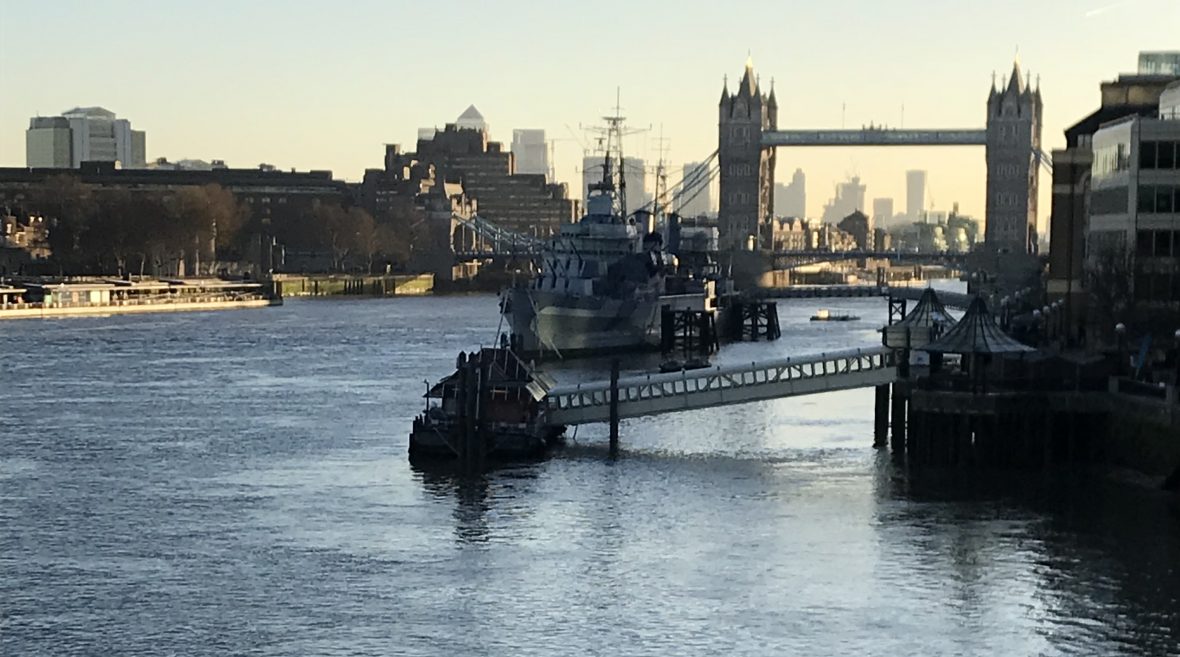
Many people know the current walkway beside the Thames, between London Bridge and Tower Bridge. About halfway along is the museum ship HMS Belfast. In the 1980s, before the walkway was created, this part of the riverfront was called Symonds Wharf. There was also a flight of river-stairs called Pickle Herring Stairs along with a causeway very close to this spot.

In the days when large cargo ships moored alongside this piece of riverfront, there was also a street running behind the warehouses that lined the river which extended east from these stairs and eventually passed under the approach road to Tower Bridge. Much of that land is now a park called Potter’s Fields. Now used by tourists to stand and admire views of Tower Bridge and the Tower of London and the site of The Greater London Authority Headquarters, City Hall.

The old thoroughfare was called Pickle Herring Street.

Potters Fields is so called because of the Dutch potters who came to work here having fled religious persecution in Holland. It was the site of the earliest Delftware kilns in England, established around 1618 and the area became famous for producing a particular variety of Delftware called ‘Pickle Herring pottery’. The theory that the Dutch fondness for pickled herrings gave the street and the nearby river stairs their name is sometimes proposed but likely to be unfounded. The precise origin is not known, but is much older.

I find the street fascinating. If for no other reason than it was right next to Tower Bridge where thousands and thousands of tourists now tread with no-one knowing (or probably caring) that once not so long ago people lived there packed into cramped and horrid conditions carving out a meagre living in the Docks.

I have found out quite a lot about the street though.  A publication called Old and New London, published in 1878 describes the area as follows,

“From about the middle of Tooley Street, on the north side, to St. Saviour’s Dock, the whole line of street – called in one part Pickle Herring Street, and in another Shad Thames – exhibits an uninterrupted series of wharves, warehouses, mills and factories, on both sides of the narrow and crowded roadway. The buildings on the northern side are contiguous to the river, and in the gateways and openings in these we witness the busy scenes and the mazes of the shipping which pertain to such a spot. “

The following early 19th century map extract shows the area prior to the construction of Tower Bridge. Note Horsleydown Old Stairs. This is where Tower Bridge would be built later in the 19th century.

There was also a Pickle Herring Stairs roughly where St. Olave’s Wharf is shown in the 1940 map shown below. It is interesting to note that Pickle Herring street was directly opposite Traitor’s Gate of the Tower of London. I struggle to imagine how much money a person would need to live in such a prime location today. 

1940 map showing Pickle Herring Street

The following two photographs from 1947 and 2015 respectively show how the area has changed in so little a time really. The 1947 photo immediately below is looking East towards Shad Thames now a site for high end restaurants and even higher end flats and apartments,

Pickle Herring Street looking East towards Shad Thames

and this photograph looking west shows what is now the site of the seat of London Government, City Hall built on Potter’s Field.

Pickle Herring Street, 2015

When the south bank of the Thames was redeveloped in the 1980s, a new river-wall, from London Bridge to Tower Bridge was built and anything pre-1980 was cleared away. All reference to Pickle Herring Street was lost.

There is mention of Picked Herring Wharf in the novelist and historian Walter Besant’s book East London, 1901 together with this illustration which shows the bridges in the Wharf which can also be seen on the 1947 photograph above:

Additionally, the artist and illustrator Gustav Doré visited the area in about 1872 and produced this illustration of the Wharf:

Pickled herrings are an age-old method of preserving a very well-known fish. They are also known as rollmops. Pickled herring fillets, usually served these days rolled up with onions or gherkins inside and bought in a jar or other container of vinegar. They are well-known and eaten in Britain as well as being even more popular in Europe and particularly Scandinavia. The idea of a pickled herring in London is known to go back to the days of the Domesday Book in 1086 where Herrings and Southwark are mentioned together in a reference for the ‘Guildable Manor of Southwark’. This manor extended from the southern end of London Bridge, along the riverside, almost as far as Hay’s Wharf Dock nearer to London Bridge.

This mention is related to lands held by Odo the Bishop of Bayeux. Along with several pieces of land in England, there is a reference to ‘Oxted and Walkingstead, in Tandridge Hundred, land of Count Eustace’. Under this entry, it says ‘The Count holds Walkingstead himself … To this manor belong 15 dwellings in Southwark and in London, at 6s, and 2000 herrings’. The mention of the ‘six shillings’ and also the herrings probably indicates that taxes had been levied and were payable partly in money and the rest in herrings. Because fresh fish would not have kept, it is likely that the Herrings would have been pickled before being handed over in payment.

Pickle Herring Stairs could be the place where the herrings were landed, pickled and used as a kind of currency.

Who knows? But it’s an intriguing story.

A Bermondsey Life …

Elizabeth Regan (about 1859 – 1921)

Elizabeth was the youngest of the nine children I have so far found of Jeremiah Regan and Bridget Monahan who are one set of my maternal 3 x great grandparents. So, Elizabeth Regan was my maternal 3 x great Aunt.

Elizabeth had quite a life; she married three times, was widowed twice, separated from her second husband (it seems) may have left a child in the Workhouse and died in the Workhouse infirmiary.

A studio portrait of Elizabeth taken in, I suspect, the 1880s or 1890s

Elizabeth was born in Bermondsey in about 1859. She lived with her family until she married a John Butler Thomas in St Mary Magdalene Church, Bermondsey in March 1879.

John was 23 and working as a Lighterman on the river Thames. John came from Bermondsey too but in 1871 he had been working as a servant in a house in Bloomsbury, London.

John’s Father was a Lawyer rather than the more usual Labourers and Dock Workers that I’ve found in my research.

In 1870, John’s elder sister, Alice, had married one of Elizabeth Regan’s elder brothers, Timothy. So unusually, two sets of siblings from two separate families had married each other.

Witnesses at the Wedding were Cornelius Regan (another one of Elizabeth’s brothers) and Alice Regan, John’s sister, Alice Butler Thomas, who had married Elizabeth’s brother, Timothy Regan.

Elizabeth may well have met John through her brother’s marriage with John’s sister. Timothy Regan was also a Thames Lighterman and may have recommended John for employment in the Docks which was very much an industry where relatives were often brought in by existing employees to work there.

But tragedy was to strike Elizabeth and John less than a year into their marriage when, on 24th January 1880, on his 24th birthday, John Butler Thomas was killed in an accident while working on the Thames.

The Death Certificate explains that he “Drowned by falling from a barge. Under the water for four hours”. The accident was reported in the Lloyds of London Newspaper the next day, 

The outlined paragraph shown in the newspaper above, says the following,

LIGHTERMAN DROWNED ON HIS BIRTHDAY.  

A sad birthday fatality was reported to the Southwark Coroner by Mr Mummery, Officer for St Olave’s.  It appears that John Butler Thomas, living at 25 Thomas Street, a Lighterman by trade, was married but a few months since. Yesterday was his 24th birthday and it was intended to celebrate the event in a suitable manner in the course of the evening. Thomas, however, did not live to see the close of the day.  He left home as usual early in the morning and went to St George’s Terrace where he was to take charge of a barge belonging to Mr Tarnley. In attempting to push the barge from the river side to mid-stream, he slipped and fell into the water.  Efforts were made to rescue him but his body was not recovered for two hours when life was found to be extinct”

It makes me sad to think of this very ordinary family planning to celebrate John’s birthday only for him to die at work. It is particularly poignant since, three months after John died, Elizabeth gave birth to their daughter, Elizabeth, born in May 1880. 

After John’s death and daughter Elizabeth’s birth, Elizabeth Regan’s life seems to take a bit of a complicated turn.

By the time of the 1881 Census, taken on 3 April that year, so less than a year after Elizabeth had given birth to hers and John’s daughter, Elizabeth is living in lodgings and sharing them with two other women.  All three women describe themselves as Charwomen. The others are much older than Elizabeth. Elizabeth is described as the Head and the other two as lodgers. They all say they are Widows. There are, additionally, two other families living at the same address which made a total of thirteen people living in, what I suspect were, very cramped and unsanitary conditions.

I can find no trace of John and Elizabeth’s little daughter on the census for that year but I can find her death in 1887 aged just 7.

Elizabeth Butler Thomas’s Death Certificate aged just 7

Elizabeth Butler Thomas died from Potts Disease which is, apparently, a form of TB that occurs outside the lungs, usually in the vertebrae. TB can affect several tissues outside the lungs including the spine, so this was apparently a kind of tuberculous arthritis of the intervertebral joints. Little Elizabeth died in the St Olave’s Poor Law Union Infirmiary in Bermondsey

The Death Certificate says that the death of Elizabeth Butler Thomas (called Elizabeth Thomas on her death certificate) was registered by her mother who was present when the child died.  

But in the intervening time following Elizabeth Butler Thomas’s birth and death, Elizabeth Regan had in fact remarried and was now Elizabeth Waddington.

In the 19th century, it was very difficult for women to forge a successful single life. If they were widowed, women would be under pressure to remarry to have an income and someone to provide money for them to survive. Likewise, men who were widowed would need to remarry to have someone to look after their children. Although it was also common for widowed men with dependent children to distribute the children amongst relatives who would frequently, take them in.

So, in May 1882, Elizabeth had married a James Waddington, a Widower from Yorkshire, who was a Bricklayer. Their Marriage is in the same church as the one in which Elizabeth had married John Butler Thomas just three years earlier.

Elizabeth and James Waddington went on to have three children together (James’s children from his first marriage were taken in by relatives and never came to live with him and Elizabeth). I have no way of knowing whether Elizabeth and John Butler Thomas’s daughter lived with Elizabeth and her new husband. The fact that little Elizabeth died in the Workhouse infirmiary does not necessarily imply that she was living there, although she may have been. Many poor families used the Workhouse infirmary when they were ill because they could not afford to see a doctor.

In 1891, Elizabeth and James are living as a family with their three children in Bermondsey.

By the time of the 1901 census though, Elizabeth and James are living separately. James has gone back to Yorkhire where he came from originally and their eldest child has gone with him. Elizabeth is living with their two younger daughters and is again working as a Charwoman in Bermondsey.

Elizabeth is using the surname of Morris. This appears to pre-empt her third marriage to a William Morris in 1914 some 13 years later although on the 1911 Census, Elizabeth has reverted to Waddington. On that census, Elizabeth is living alone (both her girls married in 1909 – strangely, to two boys who lived next door to each other) and she is still working as a Charwoman.

Elizabeth married for the third time to William Morris, in October 1914, just a few months after the outbreak of WW1, at the Bermondsey Register Office. Elizabeth was 55. Her third husband was a Dock Worker but at the time of their marriage was serving as a Private in the 9th Cavalry Reserve Regiment and he was 11 years younger than her.

Elizabeth died in 1921 aged 61 from what appears to have been Acute Renal Failure, again in Bermondsey Workhouse Infirmary as had two of her brothers and her youngest daughter.

Her third husband, William Morris had pre-deceased her but I’m not sure exactly when. A niece of Elizabeth’s registered her death.

What a life Elizabeth had. Twists and turns amongst the poverty of south London. Three husbands, four children, disease, poverty, tragedy and the Workhouse. Tough times.